

What is a Carpet Prayer Rug?
A carpet prayer rug (seccade) is a Muslim’s smallest home. It is the earthly equivalent of the two-square-meter grave—a sacred space where one connects with the Beyond. The word seccade comes from the Arabic root for "prostration" (sajda), and its purpose is to rise by realizing one’s own humility.
In Anatolian culture, it is also called namazlık. The most precious ones are those whose sections for the knees and forehead have worn down over the years, and those that help focus the mind entirely on worship. It is a sanctuary for those with nowhere else to go, and the best of all sanctuaries.

What is the Purpose of a Carpet Prayer Rug?
There are two dimensions to the purpose of a prayer rug: the spiritual and the material.
Spiritually
- Conditions the Soul: The moment you step onto it, you enter a defined space designed to tune your frequency for worship, helping you focus.
- Ensures Continuity: Having a dedicated space for prayer serves as a reminder of previous moments of worship, sparking a desire for the next.
- A Portable Sanctuary: Whether you change houses or countries, it allows you to carry your soul with you, reminding you of the bond you’ve built with yourself wherever you are.
- A Repository of Memories: It gathers the moments you spend in joy, sorrow, peace, fear, and repentance, acting as a kind of spiritual diary.
Functionally
- Comfort: The surface isn't hard; you won't feel pain as you spend time on it.
- Insulation: It protects your feet and forehead from the coldness of the floor.
- Hygiene: Even if the surroundings are dusty, you touch clean, pristine fibers the moment you roll it out.
Differences Between Carpet Prayer Rugs and Classic Rugs
Why do we recommend carpet prayer rugs over thin, lightweight ones? First and foremost, a carpet prayer rug is exactly that—a carpet. It has a "pile height," making it a joy to step on.
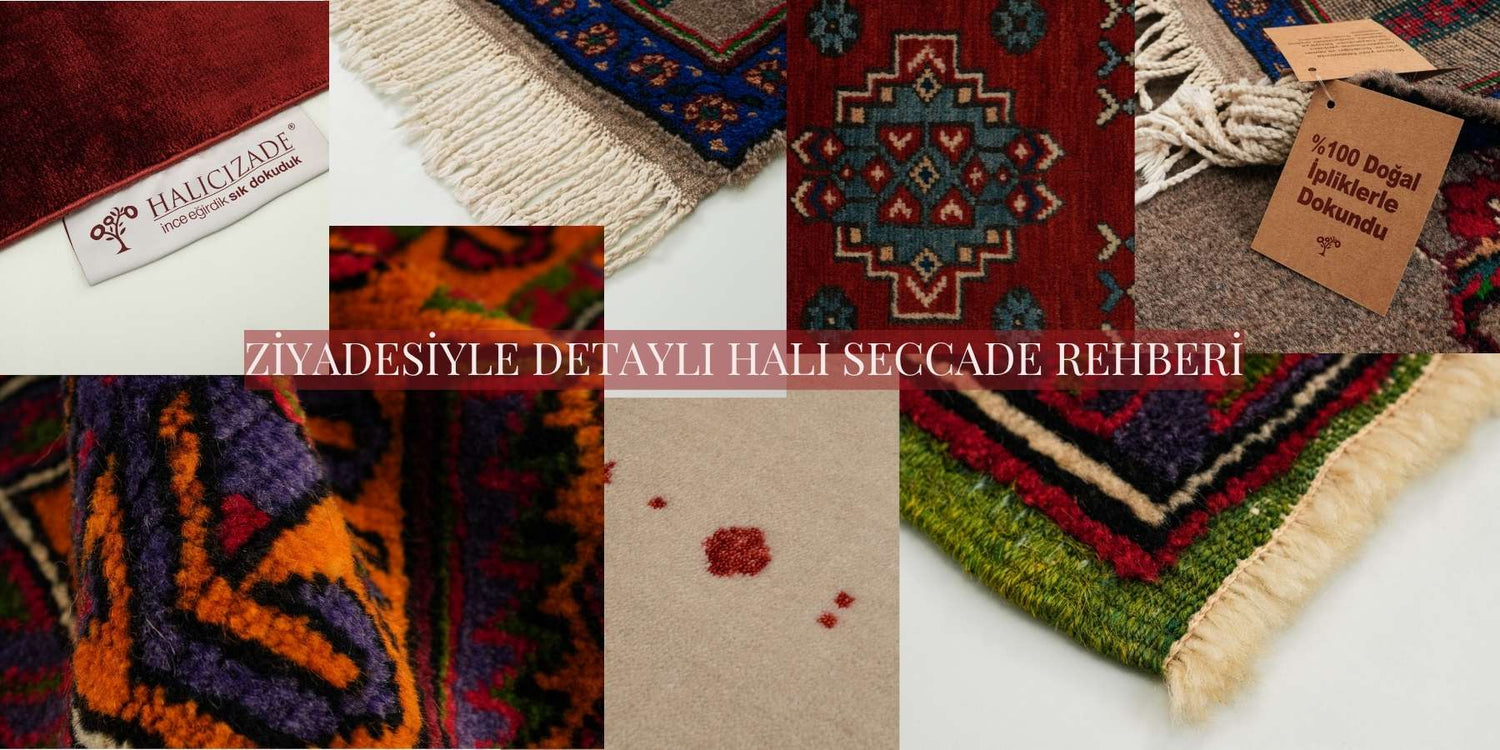
Furthermore, while almost all classic prayer rugs are woven with synthetic yarns (acrylic, polyester, etc.), carpet prayer rugs can be found in natural fibers. At Halıcızade, all of our carpet prayer rugs are produced with natural yarns.
The third difference is design. Classic rugs are industrial products woven in high volumes with generic patterns. Carpet prayer rugs—especially hand-knotted and loom-woven ones—offer unique designs and color combinations.
In antique collections, you may even find pieces woven with hand-spun wool and vegetable dyes. We can assure you: touching such a rug is a magnificent feeling.

Types of Carpet Prayer Rugs
Not all namazlıks are created equal. They vary by weaving technique, design, and age:
Hand-Knotted Carpet Prayer Rugs
When people think of a carpet prayer rug, they often imagine hand-knotted ones. The distinguishing feature of hand-knotted carpet prayer rugs is their knot density, shaped one by one through meticulous craftsmanship while creating sacred spaces for worship. While hand-knotted carpet prayer rugs made of wool and cotton are woven in less time than silk ones, they offer a softer feeling thanks to their slightly thicker structure. Another important detail is that, depending on the country and region where they are woven, their patterns and color palettes vary significantly. This makes a hand-knotted carpet prayer rug one of the most special gifts a person can buy for themselves or for someone they love.
Each region and country has its own patterns, making these rugs one of the most special gifts one can give to themselves or a loved one.

Machine-Woven Carpet Prayer Rugs
As machine weaving has grown, prayer rugs have followed suit. These usually feature acrylic, viscose, or cotton blends. They are the most economical way to experience the comfort of a carpet prayer rug.
Modern Design Prayer Rugs
Where are the rugs that reflect today’s understanding of worship? Many traditional patterns carry traces of the past, but Halıcızade created the "Baş Başa" (One-on-One) series to bring modern art and culture into sacred spaces.
Its philosophy is to create a space where one can remain "one-on-one" with their Creator in today's distracting world, using a design language rooted in simplicity and shedding excess.

Traditional Motifs
The hallmark of traditional rugs is the mihrab (niche) design, which points toward the direction of prayer. These are perfect for those who find peace within dense, classical patterns.
Loom-Woven (Hand-Loomed) Prayer Rugs
As hand-knotted production decreases and machine-made rugs often lack "soul," loom-woven rugs have become a highlight of the Halıcızade collection. They offer a feel close to hand-knotted rugs but at more budget-friendly prices.

What to Consider When Choosing a Carpet Prayer Rug
Choosing the right rug is a personal journey. Here is what to look for:
- Yarn Type: We recommend natural fibers. Our nature is inclined toward the natural, and using natural yarns aligns with the very spirit of worship.
- Weaving Technique: Decide based on your budget and the uniqueness of the design.
- Thickness and Density: Some prefer plush softness (7–12 mm), while others prefer something thinner.
- Floor Compatibility: If you are placing it on a stone floor, we recommend a rug that won't slip.
- Aesthetic Harmony: Spaces have souls. Choosing a piece that matches the design language of your room will help you focus and increase the "flavor" of your worship.

Who is a Carpet Prayer Rug For?
It is perfect for those who love creating personal sanctuaries and deepening their spiritual feelings. It is also an extraordinary gift. Imagine giving a gift that ensures you are remembered every time that person prays.
How to Identify Quality
In a prayer rug, the yarn is everything. Because we touch it with our bare feet, palms, and forehead, the tactile sensation is paramount. Quality is felt first through the fiber and then seen in the grace of the patterns.
Maintenance and Cleaning
Cleanliness is a fundamental requirement of prayer. Rugs should be vacuumed regularly and wiped once or twice a year with a cloth dampened with white soap and water.
Since they are used with clean clothes and socks, wiping and vacuuming are usually sufficient for decades of use.
The Halıcızade Approach
Our perspective combines deep roots with a fresh outlook. From our minimalist Baş Başa series to antique masterpieces collected from auctions, we offer unique options for those who want to turn their prayer space into a work of art.

Frequently Asked Questions (FAQ)
- Is it healthy?
- Yes, especially when made from natural fibers, it is a healthy companion that will witness your prayers for years.
- Can it be washed?
- Most can be professionally cleaned.
- Where is it used?
- Typically in bedrooms, private prayer rooms, or masjids.
- How thick should it be?
- We recommend 7–12 mm for knee comfort. Anything above 12 mm is for those seeking extra plushness.
- Does it slip?
- Generally, they do not slip unless used on very slick stone surfaces.


Leave a comment
This site is protected by hCaptcha and the hCaptcha Privacy Policy and Terms of Service apply.