
Turkmen gül medallions on cream, in silk and viscose
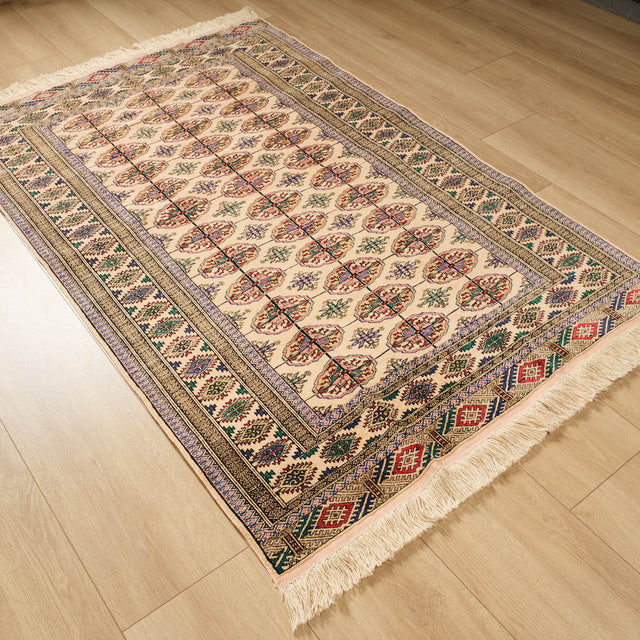 115×175 cm



Rugs & Kilims
Find Your Rug
For those who already know what they are looking for — Halıcızade's most visited collections.
Turkmen gül medallions on cream, in silk and viscose
115×175 cm
Two rows of medallions on mustard, knotted thin and close
 80×111 cm
Ranks of Turkmen medallions, hand-knotted in Afghan wool
 85×140 cm
The Tekke repeat on burgundy, cream and yellow at even spacing
 133×187 cm
Turkmen tent drawing, closely knotted, cream and black on burgundy
 131×184 cm
A Turkmen rug is a hand-knotted wool rug woven by the Turkmen of Central Asia, recognized by a deep madder-red ground and by the gul — a repeating octagonal or diamond medallion whose exact form identifies the weaving tribe. Blue, navy, ivory and black appear in the drawing and the borders rather than in the field.
These are the most systematic rugs in the trade. Where an Anatolian village weaver improvised, a Turkmen weaver repeated a fixed device in fixed rows, and the device belonged to her tribe. Read the gul and you have read where the rug comes from. This page covers the guls, why so many of these rugs are sold as Bukharas, and what else came off the same loom.
The gul is the unit of the design. It repeats across the field in staggered rows, usually quartered internally, and it is drawn to a form each tribe kept to — Tekke, Yomut, Salor and the other Turkmen groups each have their own. The Turkish source puts it plainly: the pattern and the color identify the region and the tribe that made the rug. Nothing else in Central Asian weaving is read this way.
Between the guls sit smaller secondary medallions, and around them run narrow borders repeating a single element. The result is a surface with no center and no hierarchy, which is why a Turkmen rug looks calm from a distance and dense up close. The field is deep red almost without exception, and the drawing is carried in dark blue, ivory and black.
Because of where they were traded, not where they were made. Bukhara was the great market of Central Asia, and rugs brought there for sale took the market's name with them into European and Turkish usage. A rug labeled Bukhara is a Turkmen rug in almost every case, and its diamond-shaped repeating medallions are guls under another spelling. The naming is worth knowing when you compare listings, since two rugs described as Bukhara and Tekke may be the same object.
A Turkmen household wove its furniture. The pile rug on the floor was one product of the loom among several, and the small formats that survive were made for purposes that have nothing to do with a living-room floor.
| Woven object | Its original use | How it is used now |
|---|---|---|
| Floor rug | The main covering of the tent or house floor | Living rooms, studies, bedsides |
| Door piece | Hung across the tent entrance as a curtain | Wall hanging, or a rug for an entry |
| Bags | Storage and transport of household goods on migration | Cushion faces, wall pieces, collectors' items |
| Animal covers | Trappings for camels and horses | Display pieces |
| Wall weavings | Insulation and decoration inside the tent | Hung as textile art |
The motifs carried the same double duty. A design could mark social standing, a marriage, a birth — which is why Turkmen weaving is read as social record as much as decoration.
Wool, from local sheep, is the standard for both foundation and pile; it gives the rug its weight and its resilience. Cotton and silk are used for fine detail and for highlights rather than for whole rugs. The color comes from plant dyes, and the reds are the madder family — which is why an old Turkmen field reads brick and garnet rather than pillar-box red, and why it darkens rather than fades.
Turkmenistan is the homeland of the tradition, and most Turkmen-pattern rugs reaching the market today are hand-knotted in northern Afghanistan by Turkmen weaving communities there; the pieces in this collection are cataloged accordingly. Compare Afghan rugs for the neighboring tradition, and wool rugs for the fiber on its own.
The tradition runs from very small formats up to room sizes of around six square meters, in rectangles mostly and occasionally squares. The pieces here are the small end of that range — roughly 80 × 111 cm (2'7" × 3'8") to 133 × 187 cm (4'4" × 6'2") — which is the size that suits an entry, a bedside, a study or a landing rather than a seating group. A deep red field does specific work in a room: it absorbs light rather than reflecting it, holds its own beside dark wood, and reads warm against gray and ivory walls. Browse hand-knotted rugs and ethnic-pattern rugs for the wider selection.
Vacuum regularly so that grit does not work down into the base of a dense pile, which is where it cuts fibers. Treat a spill by blotting with a cloth wrung out in cold water, working from the edge inward, and match the treatment to the stain rather than reaching for a general-purpose cleaner. Send the rug to a professional for washing. Keep it out of direct sun and away from heat sources, avoid strong chemical cleaners entirely, and make sure it is completely dry before it goes back down. See how a rug is washed for the full procedure.
A Turkmen rug is a hand-knotted wool rug woven by the Turkmen of Central Asia, on a deep madder-red ground patterned with repeating guls. The gul is an octagonal or diamond medallion whose exact form identifies the tribe that wove the rug.
A gul is the repeating medallion that fills the field of a Turkmen rug, set in staggered rows and usually quartered internally. Each Turkmen tribe, among them Tekke, Yomut and Salor, keeps to its own form, so the gul identifies the rug's origin.
In almost every case, yes. Bukhara was the Central Asian market where these rugs were traded, and the name attached to the goods rather than to their place of manufacture. A Bukhara rug's diamond medallions are Turkmen guls under another name.
The field is deep red almost without exception, from madder dyes, with the drawing carried in dark blue, navy, ivory and black. Undyed natural tones of beige, brown and gray appear in some weavings and suit plainer modern rooms.
Wool from local sheep, for both the foundation and the pile, which gives the rug its weight and resilience. Cotton and silk appear in fine detail and highlights rather than as whole rugs, and the dyes are traditionally plant-based.
Turkmenistan is the homeland of the tradition, and most Turkmen-pattern rugs on the market now are hand-knotted in northern Afghanistan by Turkmen weaving communities. The pattern vocabulary traveled with the weavers rather than staying behind a border.
Vacuum regularly so grit does not reach the base of the pile, and blot spills with a cloth wrung out in cold water rather than rubbing. Use a professional washer for a full clean, and keep the rug out of direct sun and away from heat.
Related collections: Afghan rugs · authentic rugs · rare rugs · hand-knotted rugs


