
296 cm of corridor, a different district in every panel
 82×296 cm

One of a kind
Multicolor Patchwork Handwoven Wool Runner, Anadolu Şal Series
from
88.000 TL
≈ 36.000 TL/m²



Rugs & Kilims
Find Your Rug
For those who already know what they are looking for — Halıcızade's most visited collections.
296 cm of corridor, a different district in every panel
82×296 cm
One of a kind
from
88.000 TL
≈ 36.000 TL/m²
A corridor of wool panels, each one a different figure
 80×290 cm
One of a kind
from
84.000 TL
≈ 36.000 TL/m²
Old wool cut into panels and stitched, 117 × 185 cm
 117×185 cm
One of a kind
from
78.000 TL
≈ 36.000 TL/m²
Joined wool panels in two small sizes, handwoven in Türkiye
 118×186 cm
Sixty centimeters wide and one of one: wool patchwork runner
 65×172 cm
Panels drawn after Hereke, Kayseri and Oushak, woven in India
 200×300 cm
Hereke, Oushak and Kayseri drawing, split across three grounds
 200×300 cm
Wool patchwork, 123 × 209 cm, seams where a pattern would be
 123×209 cm
One of a kind
from
93.000 TL
≈ 36.000 TL/m²
Navy and orange patches over earth, all one knotted piece
 250×341 cm
One of a kind
from
310.000 TL
≈ 36.000 TL/m²
Green beside orange, burgundy beside purple, seams left showing
 242×295 cm
One of a kind
from
260.000 TL
≈ 36.000 TL/m²
Four town patterns on one floor, 240 × 301 cm of wool
 240×301 cm
One of a kind
from
265.000 TL
≈ 37.000 TL/m²
Squares from different Anatolian looms, brought together in Kütahya
 200×300 cm
Beige squares in a grid that drifts, wool knotted loop by loop
 170×240 cm
Red laid over cattle hide, the grain still showing through
 165×232 cm
Damask drawn in cream over a beige cowhide ground
 180×240 cm
Squares of South American hide, mink gray-brown throughout
 200×240 cm
Pale hide in brick courses, no two pieces the same beige
 210×255 cm
Black hide laid like brickwork, a few pieces flecked silver
 195×220 cm
Fuchsia against anthracite, panels out of Bünyan, Isparta, Ladik
 111×170 cm
One dye bath, a dozen reds, black panels cut across them
 113×171 cm
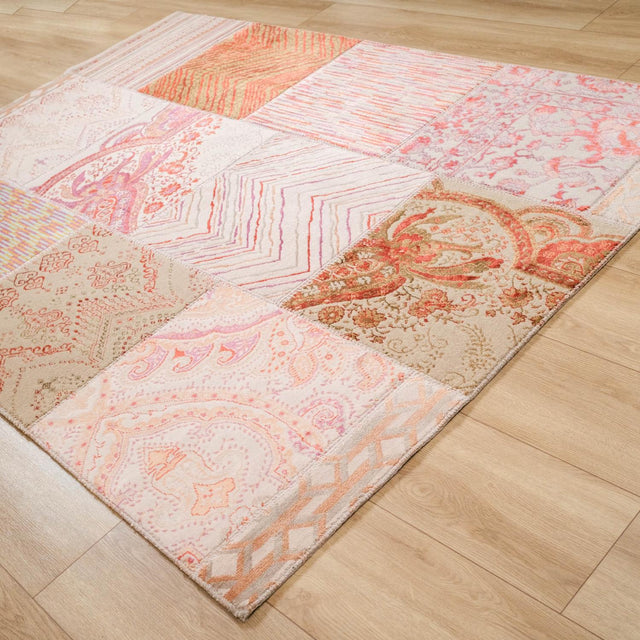
Woven as one piece, not cut and sewn: pink, peach, lilac, gold
 170×240 cm
Panels drawn whole rather than salvaged, in first-grade wool
 81×293 cm
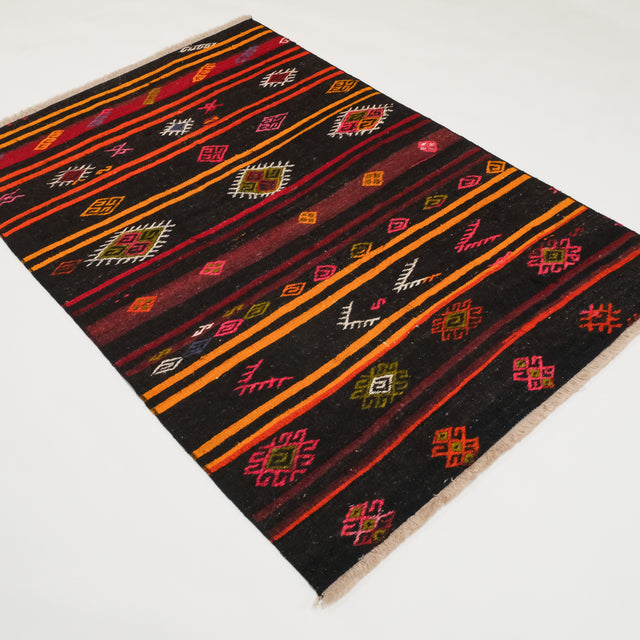
Four colors take turns up a black flatweave, all wool
 120×180 cm
Cowhide dyed blue, cut square and stitched panel to panel
 90×147 cm
A patchwork rug is made by cutting older rugs into panels and rejoining them into one rectangle, so that colors, patterns and fabrics from different traditions sit side by side in a single piece. The panels are not meant to match. The interest lies in how unlike pieces hold together, and no two finished rugs are the same.
This page covers how a patchwork rug is put together, the three different products sold under the name, what to look at before buying one, and why a patchwork rug is cleaned differently from an ordinary pile rug.
It begins with rugs that already exist. Patchwork is a way of using the old — the same idea that recurs in clothing — and it works unusually well on rugs, because a worn rug often has sound areas long after the piece as a whole has stopped being usable. Several rugs of different design are cut into panels, the panels are arranged for balance rather than for match, and they are joined edge to edge into a new rectangle.
The judgment is in the arrangement. A panel of dense red border next to a pale open field is a decision, not an accident, and the maker's eye is the difference between a rug that reads as one object and a rug that reads as a pile of offcuts.
| Type | How it is built | Surface and feel |
|---|---|---|
| Handwoven panel patchwork | Panels cut from older handwoven wool rugs, arranged and stitched | Firm underfoot; the pile height varies slightly between panels |
| Machine-woven patchwork | The patchwork effect woven or assembled from machine-made ground | Even in height across the whole rug; lighter |
| Hide patchwork | Leather panels cut to geometric shapes and joined | Flat, smooth, sits close to the floor |
Hide patchwork behaves like a different product altogether: the geometry is cut rather than woven, and the rug lies almost flush with the floor. See cowhide rugs for that construction on its own. The wool panels themselves usually come from vintage rugs, and dyed-down single-color treatments of the same idea sit in overdyed rugs.
Because the input is finite. Each source rug supplies a limited number of usable panels, and once they are used the combination cannot be repeated. This is also why patchwork is where turquoise, pink, purple, black and red turn up in strengths you rarely see in a single-design rug: the color comes from whatever the source pieces happened to be.
Anywhere a room needs one strong object rather than a background. Patchwork suits bohemian, ethnic and vintage interiors by temperament, and it does something better in a minimal room — it becomes the only pattern in the space, which is a stronger position than competing with wallpaper. Bedrooms, teen rooms, corridors and winter gardens all take one. In a small space a round rug removes the corners and the panel geometry reads more easily.
One expectation to set: a patchwork rug is not soft. The panels and their seams make a firmer, harder surface than a shaggy rug, and it is bought for what it looks like rather than for what it feels like underfoot.
Vacuum gently, and never beat it. Beating a patchwork rug puts a shock load on the stitching, which stretches the seams and eventually tears them; one or two passes with a vacuum a week does the same job without the risk. Follow the maker's instructions for anything beyond that, since the panels may not all be the same fiber.
Use a rug shampoo with no bleach in it. Handwoven panels are usually wool and cotton, and both want a gentler treatment than a synthetic pile. Professional washing once a year — twice at most — is enough for both wool and hide constructions.
Panels cut from existing rugs of different colors and patterns, joined edge to edge into a single rectangle. The panels come from separate source rugs and are not meant to match; some patchwork is made instead from cut leather panels.
Each source rug yields a limited number of usable panels, so once a combination is used it cannot be made again. The palette of any given rug is set by whatever the source pieces happened to be rather than by a chosen color scheme.
No. The panels and their seams give a firmer, harder surface than a shaggy or long-pile rug. A patchwork rug is chosen for its appearance and its color rather than for the feel of the pile.
It should not be. Beating puts a sudden load on the stitched seams, which stretches them and can tear the joins. Vacuuming gently once or twice a week removes the same dust without stressing the construction.
Vacuum gently and regularly, and use a rug shampoo that contains no bleach. Follow the maker's instructions, since the panels may not all be the same fiber. Professional washing once or twice a year is enough for both wool and hide constructions.
Both are made. Handwoven patchwork uses panels cut from older handwoven rugs and varies slightly in pile height between panels; machine-woven patchwork is even in height across the whole rug and lighter to handle.
Bedrooms, teen rooms, corridors and winter gardens all take one, and a minimal room suits it particularly well because the rug becomes the only pattern in the space. Round formats work better than rectangles in small rooms.
Related collections: vintage rugs · overdyed rugs · cowhide rugs · round rugs


