
Scandinavian lines in mink, and the rush throws its own shadow
 120×180 cm



Rugs & Kilims
Find Your Rug
For those who already know what they are looking for — Halıcızade's most visited collections.
Scandinavian lines in mink, and the rush throws its own shadow
120×180 cm
Anthracite, no drawing at all — the ribs do the work
 120×180 cm
One of a kind
from
10.700 TL
≈ 5.000 TL/m²
 120×180 cm
Bands of brown on rush fiber, woven flat in India
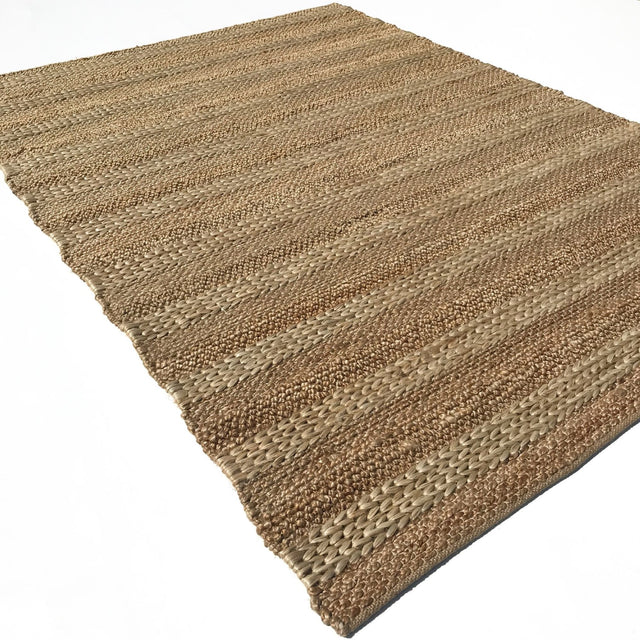 120×180 cm
Coiled discs laid over each other, five colors, no pile
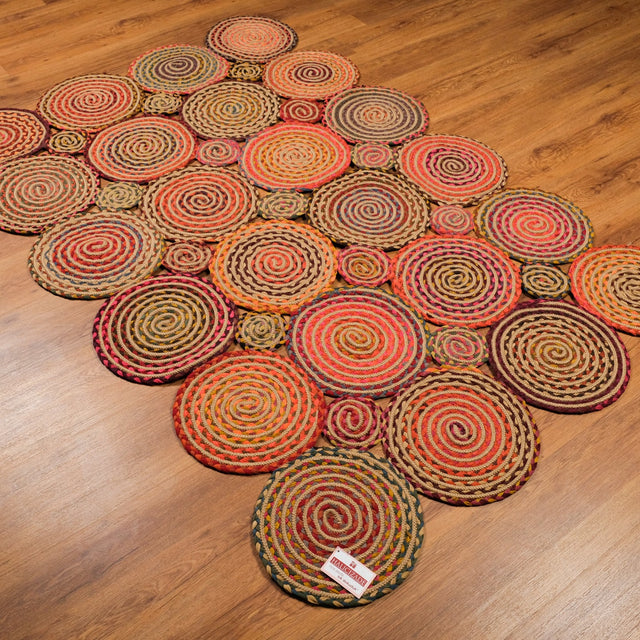 170×240 cm
Anthracite jute from the Ganges, and never any water
 170×240 cm
Rush beside wool: cream, and dry cleaning only
 170×240 cm
A jute rug is a flat-woven floor covering made from the spun stem fiber of the jute plant. The rugs collected here are handwoven in India in jute, jute-and-cotton and rush weaves, in the fiber's own cream through brown and charcoal, from 80 × 150 cm to 250 × 350 cm. Jute browns and weakens when it gets wet.
That last sentence decides more about where one of these rugs can live than color, size or price does, so this page starts there. After the water comes what is actually in the collection, how the weaves differ from one another, the sizes, and how the rugs are cleaned.
Jute is cellulose, and cellulose bonds readily with water. A jute rug wets through quickly, holds the water in the core of a thick, low-twist yarn, and dries slowly. Three things follow from that.
So a jute rug does not belong in a bathroom or a kitchen. Not in front of a sink, not on an open balcony, not in a basement, and not in the bay of a window where condensation runs down onto the floor. That is the opposite of the way jute is usually sold, and it is the honest version: where water is expected, the right object is a washable cotton or synthetic weave — the kitchen rugs are chosen on exactly that basis — and no amount of care turns jute into one. The fiber itself, from the field to the loom, is set out in what a jute rug is.
Nine rugs, and they are not all the same thing. The Otto Jüt and Echo Jüt series are jute: handwoven flatweaves from Indian workshops, in the fiber's own cream and golden brown. The Bolga and Fuji series are woven in the same idiom and the same weight — plain, striped or lightly geometric, some carrying cotton in the weft — in cream, anthracite, brown and mink.
One rug in the collection is not a plant fiber at all. The Sisal Series is machine-woven in Türkiye from synthetic yarn in a weave that reads as sisal, and it is here because it answers the same brief — flat, neutral, textured — on a floor where a plant fiber would fail. It is a look-alike rather than sisal; the listing gives the construction as machine-woven and the yarn as synthetic.
Jute is a bast fiber, taken from the stem of the plant rather than the leaf. The cut stalks are retted — sunk in slow water until bacteria loosen the bark from the woody core — then stripped by hand, dried, combed and spun into a coarse, low-twist yarn. That yarn is woven flat over a jute or cotton warp, usually in a basket or herringbone structure, or plaited into a rope and coiled and stitched, which is where round jute rugs come from.
Jute takes dye poorly next to wool. Most of what is on this page is the fiber's own color, sometimes bleached toward oatmeal or surface-dyed to a flat charcoal that sits on the yarn rather than penetrating it. A saturated color in a jute weave almost always means a blend.
| Weave | What it is | Underfoot | With water | Where it works |
|---|---|---|---|---|
| Handwoven jute flatweave | Pure jute, spun and woven in India | Softest of the three; a slight give | Poor — absorbs fast, browns as it dries | Dry living rooms, bedrooms, studies, layering |
| Jute and cotton flatweave | Jute warp or weft carrying cotton | Flatter and lighter; a smoother hand | Poor — cotton takes up water as readily | Dry rooms where a lighter, tighter surface is wanted |
| Machine-woven sisal-look | Synthetic yarn woven in Türkiye | Firm and flat, with little give | Tolerant — rinses and dries without marking | Entrances, balconies and floors that get damp |
In a dry room, on a hard floor, under furniture. Jute reads as texture rather than pattern, which makes it the most forgiving thing to put under a sofa in a room that already has plenty going on. It is also the standard base layer: a large jute flatweave with a smaller wool rug or a kilim laid over one corner covers a whole floor for a fraction of what a room-sized rug of either would cost.
The sizes run 80 × 150 cm (2'7" × 4'11"), 120 × 180 cm (3'11" × 5'11"), 140 × 200 cm (4'7" × 6'7"), 170 × 240 cm (5'7" × 7'10"), 200 × 300 cm (6'7" × 9'10") and 250 × 350 cm (8'2" × 11'6"). The two largest are the layering sizes. A covered winter garden works if it stays genuinely dry; a rug that goes out there should come back in when the weather turns.
For a floor that has to take wear for decades rather than years, the answer is a different fiber altogether — see wool rugs — and the wider plant-fiber selection sits in natural-fiber rugs.
Dry, and mechanically. Vacuum on low suction with the beater bar switched off, in the direction of the weave, and shake or beat a small rug outdoors rather than washing it. The listings in this collection specify dry cleaning or professional washing; none of these rugs is built for a domestic drum.
For a spill, act at once. Blot with a dry white cloth, work from the outside of the mark inward so the edge does not spread, and dry the spot with a fan rather than heat. With jute the wrong first move is the one that leaves the ring, and the ring is permanent.
Bathrooms and kitchens first of all, and any floor that is regularly damp: an open balcony, a basement, or the strip under a window where condensation runs down. Jute takes up water fast, dries slowly, and browns as it dries.
It browns and it weakens. As the rug dries, the fiber's own lignins and sugars travel to the surface and leave a tan halo around the wet area. The fiber also loses strength while it is saturated, and repeated wetting makes it brittle at the wear points.
Only a covered one that stays dry, and it should come indoors when the weather turns. Rain, dew and standing water all mark jute permanently, and a rug left damp against a cold floor will smell of mildew before anything shows on the surface.
By dry methods. Vacuum on low suction with the beater bar switched off, in the direction of the weave, and shake or beat a small rug outdoors rather than washing it. The listings here specify dry cleaning or professional washing, not a domestic machine.
No. It is machine-woven in Türkiye from synthetic yarn in a weave that reads as sisal. It sits in this collection because it gives the same flat, neutral texture, and it tolerates water in a way that none of the plant-fiber rugs here does.
From 80 × 150 cm (2'7" × 4'11") up to 250 × 350 cm (8'2" × 11'6"), with 120 × 180, 140 × 200, 170 × 240 and 200 × 300 cm in between. The larger sizes are the ones most often used as a base layer under a smaller wool rug or kilim.
Related collections: natural-fiber rugs · flatweave rugs and kilims · wool rugs


