


How to Tell If a Rug Is Handwoven


A handwoven rug is identified from the back, not the front. Turn it over: hand-knotted work shows the pattern in slightly uneven rows of knots that match the face color for color, and the fringe is the warp itself, running out of the weave. A machine-woven back is a regular mesh with a stitched-on fringe.
That single test settles most cases in about ten seconds. The rest of this page is the sequence a dealer runs when it does not — eight checks in order, what each one proves, what it cannot prove on its own, and the trick used to defeat it. You can run all eight in a shop, in daylight, without tools.
What handwoven covers, and what it does not
Handwoven covers two structures, and excludes two others that are commonly sold beside them. A hand-knotted rug is built knot by knot: short lengths of pile yarn tied around pairs of warp threads on a vertical loom, locked in place by a weft passed after every row, then beaten down and trimmed. A flat-woven kilim has no pile at all — the weft itself carries the pattern and is packed tight enough to hide the warp. Both are made entirely by hand and both pass the checks below.
Two products do not. A loom-woven rug is made on a hand-operated loom with a controlled weave structure rather than tied knots, which is honest work sold under its own name and explained in what a loom-woven rug is. A hand-tufted rug is punched into a stretched canvas with a hand-held gun and held there by an adhesive coat and a cloth backing, so a human made it and no one knotted it.
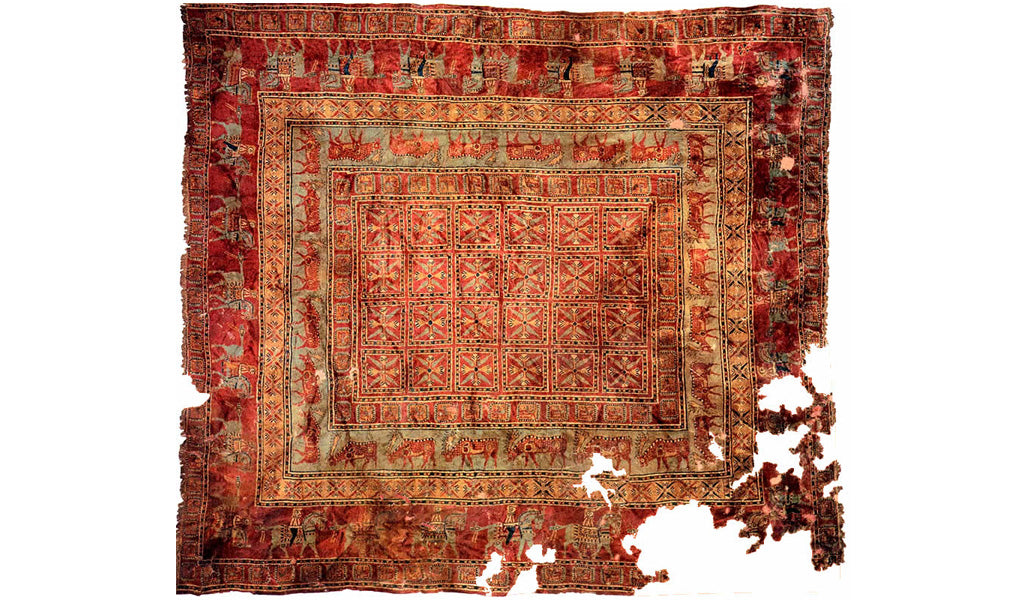
The structure you are looking for is very old. The Pazyryk rug, cut from a frozen Scythian tomb in the Altai mountains and now in the Hermitage, is roughly two and a half thousand years old and tied with a symmetrical knot — the same thing you are about to look for on the back of a rug in a shop.

The eight checks, in the order a dealer runs them
Work from the back forward and from structure to finish; the early checks decide most rugs, and the later ones catch the ones that survive the early checks.
- Turn it over and read the back. On a hand-knotted rug the pattern reappears on the reverse, knot by knot, matching the face color for color, in rows that are not quite even. A machine back is a flat, regular mesh, often with a visible backing cloth, and the pattern is muffled rather than repeated. Proves: knots were tied individually. Does not prove: age, fiber, or where it was woven. The trick: a printed or coarsely woven back that mimics the look — press a thumbnail between two rows, and on a real rug you will feel discrete knot collars rather than a continuous ground.
- Follow the fringe into the weave. On a handwoven rug the fringe is the warp continuing past the last row of weft, so it is structural and it is the same fiber as the foundation — usually cotton, sometimes wool or silk. The lengths and thicknesses vary slightly because a hand made them. Proves: the ends belong to the rug. Does not prove: handwork by itself, because an old handwoven rug may have had its fringe replaced honestly. The trick: a fringe sewn or glued on after weaving — look for a seam line across the end, and pull gently; an applied fringe moves as a strip.
- Read the knots for irregularity. A weaver tying several thousand knots a day cannot make two of them identical, so the rows wander microscopically and the knot heights vary. Worth separating two words that get confused here: irregular means the knots are not identical because a person tied them, while an asymmetric or Senneh knot is a structural type that wraps one warp and passes under the next. Both the symmetrical Gördes knot and the asymmetrical Senneh knot are hand knots, as set out in the Turkish knot and the Persian knot. Proves: a hand at work. Does not prove: quality — irregularity is evidence, not virtue.
- Fold the rug back on itself and part the pile. Bend a corner over your forearm and push the tufts apart down to the foundation. On a hand-knotted rug you can see the knot collar wrapped around a pair of warps, and the fold opens into a clean line of knot bases. On a hand-tufted rug you reach a scrim cloth and a layer of adhesive instead. Proves: how the pile is anchored, which is the one thing a photograph never shows. The trick: none worth the effort — this is the check that catches tufted rugs.
- Pick it up. A hand-knotted wool rug is heavy for its size, because a dense foundation and thousands of knots per square decimeter add up. Proves: very little on its own. Does not prove: handwork, and this is the check people over-trust — a latex-backed tufted rug is also heavy, and a fine silk rug is light. Use weight to confirm the others, never to settle a question.
- Run your hand along the long edges. The selvedge on a handwoven rug is the outermost warps wrapped in yarn, continuous with the foundation and often rebound at some point in a slightly different wool. A machine-woven or tufted rug is finished with an applied overlock stitch or a bound tape. Proves: the edges grew with the rug. Does not prove: much on an old piece, where honest rebinding is normal and expected.
- Compare the two halves of the pattern. Fold the rug lengthwise in your mind and read one border against the other. Handwork drifts: a motif is a few millimeters wider at one end, a line of guard border loses a repeat in a corner, a medallion sits fractionally off the long axis. Machine work does not drift, because the design was fed to the loom the way a file is fed to a printer. Proves: the drawing was carried by a person. The trick: deliberate irregularity programmed into a machine design — it repeats, which is the giveaway, since real drift never happens twice in the same way.
- Measure it. Handwoven rugs are rarely an exact commercial size, and the two ends are rarely the same width to the centimeter, because warp tension changes as the rug grows up the loom. A rug that measures 200 × 300 cm (6'7" × 9'10") to the millimeter, with perfectly parallel edges, was almost certainly not made by hand. Proves: the loom was under human tension. Does not prove: anything on a rug that has been stretched and blocked after washing.


What each check proves, and how each one is defeated
No single check is conclusive; run them together and the answer is rarely in doubt.
| Check | What it proves | What it cannot prove | How it is faked |
|---|---|---|---|
| 1. The back | Knots were tied one at a time | Age, region, fiber, value | A woven backing printed or textured to suggest knots |
| 2. The fringe | The warp runs out of the weave | That the fringe is original to an old rug | A fringe stitched or bonded on after weaving |
| 3. Knot irregularity | A hand tied them | Skill, density or worth | Randomization written into a machine pattern, which then repeats |
| 4. The fold | How the pile is anchored to the foundation | Which knot type was used | Effectively nothing — tufted backing cannot be hidden |
| 5. Weight | Density, roughly | Handwork; latex backing is heavy too | A heavy secondary backing on a tufted rug |
| 6. Selvedges | The edges are part of the structure | Originality, since rebinding is normal | Hand-stitched overlock applied to a machine edge |
| 7. Pattern drift | A person drew and corrected as they wove | Where the drawing came from | Programmed variation that recurs identically across the field |
| 8. Measurement | The rug grew under changing tension | Anything, if the rug was blocked after washing | Trimming and binding a handwoven rug to a round number |
The three products these checks separate
Almost everything sold as handmade that is not hand-knotted falls into one of three groups, and only one of them is dishonest.
- Hand-tufted. Pile punched through a stretched canvas with a tufting gun, fixed with adhesive and closed with a cloth backing. It is made by a person and it is not knotted, so the fold test finds it at once. Sold as tufted, it is a fair product at a fair price. Sold as hand-knotted, it is not.
- Machine-woven in a traditional pattern. A power loom reproducing an Anatolian design at scale, with a mesh back, an applied fringe and flawless symmetry. Nothing is concealed and the price says so; these are the rugs that belong in a corridor or a first apartment. Compare the machine-woven rugs with the hand-knotted rugs and the difference on the back is unmistakable.
- Loom-woven and described loosely. The rug is genuinely woven on a hand-operated loom, and the words used for it slide toward "handmade" in conversation. Ask the direct question — is the pile knotted, and by whom — and a serious seller will answer it in a sentence.

If you have two minutes
Run checks 1, 2 and 4 and stop. Turn the rug over and look for knots rather than mesh; follow the fringe into the weave and confirm it is the warp; fold a corner back and look for a knot collar rather than a glued scrim. A rug that passes those three is handwoven, and everything after that — region, fiber, dye, density — is a question about which handwoven rug you are holding. Pattern will tell you where it came from, which is the subject of the rug pattern guide; fiber tests, particularly for silk, are set out in the silk rug guide; and whether the rug is as old as the seller says is a separate sequence again, in antique versus vintage handwoven rugs.
Frequently asked questions
How can I tell if a rug is handwoven?
Turn it over. A handwoven rug shows its pattern on the back in slightly irregular rows of individual knots, matching the face color for color, and its fringe is the warp continuing out of the weave. A machine-woven rug shows a uniform mesh and a stitched-on fringe.
Is an irregular knot the same as an asymmetric knot?
No. Irregular describes knots that are not identical to one another because a person tied them, which is evidence of handwork. Asymmetric describes the structure of a single knot, one that wraps one warp and passes under the next. Handwoven rugs use symmetrical and asymmetrical knots alike.
Does the fringe prove a rug is handwoven?
It is strong evidence and not proof. On a handwoven rug the fringe is the warp itself emerging from the weave, while a machine-woven or tufted rug has a fringe sewn or glued on as a separate strip. An old handwoven rug may carry an honestly replaced fringe.
How do I tell a hand-tufted rug from a hand-knotted one?
Fold a corner back and part the pile down to the foundation. A hand-knotted rug shows knot collars wrapped around pairs of warp threads. A hand-tufted rug shows a scrim cloth and a layer of adhesive holding the pile in place, with a separate backing sewn over it.
Is a heavier rug always handwoven?
No. Weight follows density and backing rather than method, so a latex-backed tufted rug can outweigh a hand-knotted one, and a fine silk rug is light in the hand. Use weight to confirm the other checks rather than to settle the question.
Why are handwoven rugs rarely an exact size?
Warp tension changes as the rug grows up the loom, so the two ends are seldom the same width to the centimeter and the finished piece lands near a commercial size rather than on it. Perfectly parallel edges and an exact measurement point toward a machine.
Why do handwoven rugs cost more than machine-woven ones?
Time. A hand-knotted rug is tied knot by knot over weeks or months by one or more weavers, while a power loom produces the same area in hours. The price difference is labor rather than materials, which is why knot density and size move it so sharply.
Related reading: what a rug is · what knot density does and does not buy · natural versus synthetic dyes · hand-knotted rugs