
Cream heathered with gray, wool loops knotted in India
 240×340 cm



Rugs & Kilims
Find Your Rug
For those who already know what they are looking for — Halıcızade's most visited collections.
Cream heathered with gray, wool loops knotted in India
240×340 cm
Eight sizes, and the same faint moiré runs through all of them
 160×230 cm
Knots big enough to see, 2,800 grams a square meter
 100×400 cm
Scandinavian figures thin on blue, Tencel® off an Oushak loom
 130×190 cm
One of a kind
from
22.400 TL
≈ 9.000 TL/m²
Northern geometry on red, loom-woven in Oushak from Tencel®
 170×240 cm
One of a kind
from
36.800 TL
≈ 9.000 TL/m²
Scandinavian lines in mink, and the rush throws its own shadow
 120×180 cm
Eighteen millimeters deep, a white that looks knitted
 200×300 cm
Diagonals gathering inward, a plain frame, mostly polyester
 170×240 cm
Gray, and thick as a pullover: hand-knotted in five sizes
 170×240 cm
Knots as thick as stitches, cream wool out of India
 200×300 cm
Knot weight changes patch by patch: cream into beige
 200×300 cm
Geometry picked out in one tone of anthracite, knotted thick
 80×150 cm
Several creams worked into one, 3,300 g/m² at 5 mm deep
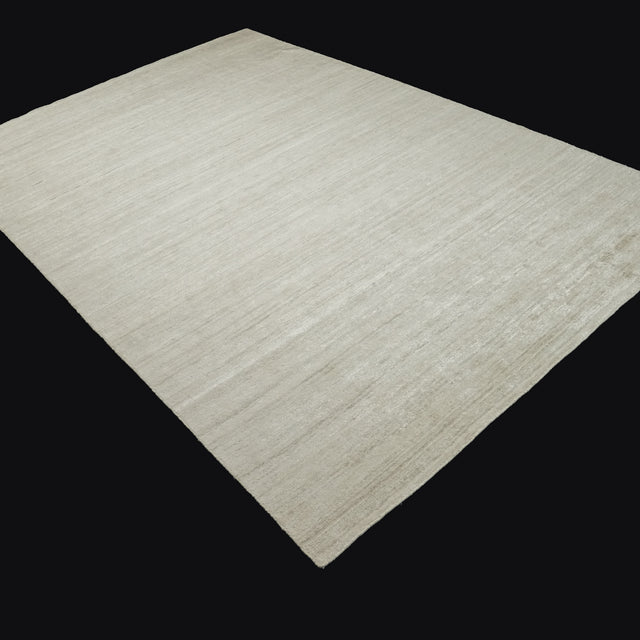 170×240 cm
Geometry a half-tone off the cream, wool from India
 200×300 cm
A Scandinavian-pattern rug is a rug drawn to the Nordic design principle of minimalism plus function: clean lines, a restricted palette of white, gray, black and pastel tones, and geometric or abstract motifs rather than dense ornament. Most are machine-woven in acrylic, cotton or synthetic yarn, and the light ground is what makes a room read as larger.
This page covers where the style came from, what it is made of, which sizes and formats it comes in, how to choose one, and how it is cleaned.
It takes things out. Minimalism works by removing the inessential and keeping only what functions, and on a rug that means simple clean lines, a limited number of colors, and pattern that stays geometric instead of elaborating. Complicated or highly detailed motifs are deliberately avoided.
The practical consequence is a rug that calms a busy room rather than adding to it. A patterned sofa, a full bookshelf and a crowded wall all sit better over a quiet floor, which is why these rugs suit interiors that already have a lot going on. See the same instinct at a broader scale in calm, minimal rugs.
Rug and kilim weaving traveled as much as it was invented. Scandinavian rug makers took a great deal from the aesthetics of Asian and Anatolian weaving, absorbed it into a northern idiom, and sent it back out as a design language of its own. That inheritance is still visible in the geometry: the forms are Nordic in scale and palette, and older than Nordic in origin. Compare the source vocabulary in geometric patterned rugs.
| Ground | What it does | Best in |
|---|---|---|
| White and off-white | Opens the floor and makes the room read wider and brighter | Small rooms, north light, dark furniture |
| Gray | Holds the middle of the value range and ties disparate furniture together | Living rooms with mixed woods and metals |
| Black | Anchors and defines; the strongest of the four | Pale rooms that need a floor edge |
| Pastel | Adds color without raising contrast; easy on the eye | Bedrooms, children's rooms, offices |
Light grounds do most of the work in this category, and white and gray are the two that combine with the widest range of furniture. See white rugs and gray rugs for those grounds on their own.
Mostly machine-woven, in acrylic, cotton and synthetic yarns. Those fibers are soft-handed and take a slight sheen, which is what gives the surface its plain, natural look and its durability under traffic. Cotton faces are straightforward to clean, and synthetic yarns are the easiest of the group to wash.
For a natural fiber in the same design language, wool versions exist and behave differently underfoot and in cleaning; see wool rugs. Some models in this category are woven for use on either face, which effectively gives one rug two lives.
The category is made across the whole size range. Large pieces suit a salon or a living room, medium sizes suit kitchens, and small formats do the work of a welcome mat in a corridor or an entrance without looking like one. Round rugs make a space read wider than a rectangle of the same area and suit rooms that are not laid out on a grid; oval formats can be made to a specified size. See round rugs for the circular formats.
Four things decide the rest.
Regular vacuuming is the substance of it. Lifting the dust that settles at the base of the pile is what keeps the surface looking clean, and periodic maintenance beats occasional deep cleaning. Rotate the rug regularly so that one area does not take all the wear.
For a deeper clean, use a rug cleaner with no heavy chemicals in it, and test it first on a part of the rug that does not show, to confirm it will not affect the color or the texture. On a stain, act quickly: lift what you can with a dry cloth or paper towel, then work with warm water and a mild soap solution, rinse the area thoroughly and let it dry in moving air out of direct sunlight, which will otherwise fade the color. Large rugs are worth taking to a professional rug cleaning service.
Minimalism combined with function: clean lines, a restricted palette and geometric or abstract motifs, with elaborate or highly detailed ornament deliberately left out. The result is a rug that quiets a room rather than adding another pattern to it.
Light tones dominate — white, gray and light brown are the most common grounds. Black and pastel versions are made for buyers who want the same drawing in a different register, and both stay within the restricted palette the style depends on.
Most are machine-woven from acrylic, cotton and synthetic yarns, which are soft to the hand and carry the wear well. Wool versions are made for buyers who want a natural fiber, and some models are woven for use on either face.
Living rooms, bedrooms, salons and kitchens all take one, and offices and corridors are served by the smaller formats. Large sizes suit a salon or living room, medium sizes suit a kitchen, and small sizes work as an entrance rug.
Modern furniture, most naturally. These rugs are drawn plainly, so they pair with simple contemporary pieces, and they are also useful under busy or heavily patterned furniture because the quiet floor lowers the temperature of the whole room.
Vacuum regularly and rotate the rug to spread the wear. For a deeper clean, use a cleaner free of heavy chemicals and test it on a hidden area first. Blot stains with a dry cloth, then treat with warm water and mild soap, and dry away from direct sunlight.
Related collections: geometric patterned rugs · calm, minimal rugs · white rugs · round rugs


