
Yağcıbedir in reverse: cream ground, wool warp and wool pile
 112×176 cm



Rugs & Kilims
Find Your Rug
For those who already know what they are looking for — Halıcızade's most visited collections.
Yağcıbedir in reverse: cream ground, wool warp and wool pile
112×176 cm
Navy for night, burgundy for fire: wool knotted onto wool
 110×173 cm
Red hearts down a navy field, 171 × 245 cm, all wool
 171×245 cm
Sındırgı wool on wool, a mihrab arch holding the center
 208×294 cm
Three meters of Yağcıbedir, wool pile over a wool warp
 84×300 cm
Night-sky navy under red geometry, wool over wool
 91×152 cm
Fringes tied in Oushak, the drawing borrowed from Yağcıbedir
 200×300 cm
İkinci elden geliyor: elde dokunmuş, tek ipliği yün
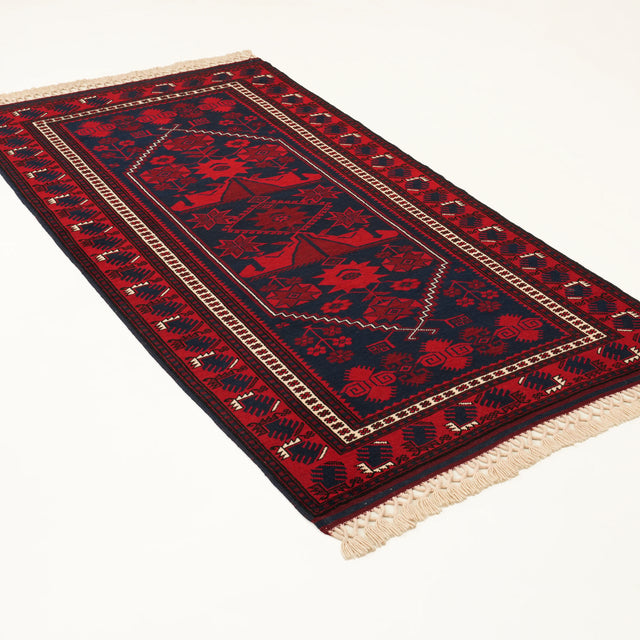 117×217 cm
A Yağcıbedir with three colors and no fourth: burgundy, navy, white
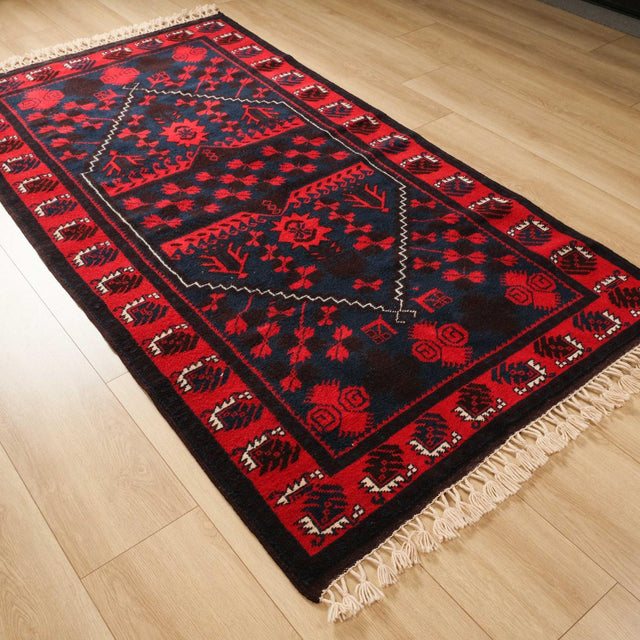 120×220 cm
A Yağcıbedir rug is a small, dark, hand-knotted wool rug in the pattern of the Yağcıbedir Yörük of Balıkesir province in western Anatolia — an indigo ground close to black, madder red and undyed white in the drawing, a lantern-shaped medallion, and a stack of narrow borders around a field smaller than you expect.
The Turkish name of this collection contains the word desenli, meaning patterned, and the distinction is worth keeping in English. The rugs here are hand-knotted in wool in Türkiye and drawn in the Yağcıbedir manner; the listings describe them as representing the Sındırgı tradition rather than as certified work from a Sındırgı loom, and this page makes no stronger claim. What follows is what the pattern is, where it comes from, and why it has held its shape for so long.
A Yörük community of Turkmen descent, settled across the Sındırgı and Bigadiç districts of Balıkesir province, in the hills behind the Aegean coast.
The group came north with the Yörük migrations out of the Taurus range and brought a pattern memory with it. Weaving in Sındırgı began as household work: a rug was made for a dowry chest, not for a market. It became a trade later, and it is now narrow enough that Sındırgı municipality runs a weekly rug market for it. Rugs in the Yağcıbedir manner are also woven outside Balıkesir today, in Kütahya, Manisa and Uşak.
Turkish rug literature divides the tradition into three types. Sındırgı is the most developed in its drawing, historically single-niche and now usually double-ended. Kepsut is a prayer-rug type throughout, single-niche, with star and flower motifs used more freely. Bergama, known from examples about a century old, is single-niche and has no footplate panel at the base of the niche.
Three colors do nearly all the work, and only two of them come from a dye pot.
The ground is indigo, taken so deep that in ordinary room light it reads as black and only opens into blue near a window. Against it sits madder — the red that runs from brick to burgundy depending on the mordant and the length of the bath. The white is the third color and it is simply undyed wool, which is why it is never quite white and why it warms toward cream in older pieces. A few rugs in this group carry a cream ground instead, which inverts the usual balance and makes the red do more.
Whether a particular rug was dyed with plants or with chemicals is a question you settle with your hands rather than with a label. Fold a tuft of pile back on itself and look down the length of the fiber: madder and indigo shift gradually from tip to root, while a flat, identical color the whole way down indicates a chemical dye. That is a difference, not a defect. A band of shifted color running clear across the field is abrash, left where the weaver came to the end of one dye lot and started another, and it is evidence of the hand. Natural and synthetic dyes sets out the test in full.
Because the pattern is inherited rather than designed.
The center of a Yağcıbedir rug is a hooked, stepped medallion that reads as a lantern hung in a niche, and the niche is the point: the field is laid out as a mihrab, the prayer arch, in one of three schemes. The oldest is a single arch at one end. The second adds a footplate panel below the arch, where the worshipper stands. The third turns the arch at both ends so that the rug has no top and no bottom, and this is the scheme most Sındırgı weaving uses now.
Around the field come the borders, and there are a lot of them — narrow bands stacked one inside the next until they take almost as much room as the field. Their repertoire has its own names: elibelinde, the hands-on-hips figure; deveboynu, camel's neck; köpek dişi, dog's tooth; the turning star. Inside the field the recurring figures are the star, the tree of life, the scales, the plane leaf and the bunch of grapes, along with the large hooked form the weavers call kocabaş.
Nothing in that list is drawn from a cartoon. A Yağcıbedir weaver learned the pattern at the loom next to her mother's, held it in memory, and reproduced it — which is the mechanism by which a design survives unchanged for generations and also the reason no two examples are identical. The density helps: the tradition is reckoned at roughly twelve knots per square centimeter, about 1,200 per square decimeter, which is fine enough for a crisp angular line and too coarse for a curve. The drawing is geometric because the weave will not permit anything else. For the wider motif vocabulary of western Anatolia, see the guide to Afghan, Karabakh, Oushak and Yağcıbedir patterns.
Yağcıbedir looms are narrow, and the rugs that come off them are correspondingly small.
| Format | Turkish name | What it is for | In this collection |
|---|---|---|---|
| Prayer rug | seccade | One person at prayer; a directional niche at one end | 112 × 176 cm (3'8" × 5'9") |
| Bedside rug | karyola | Laid along the side or the foot of a bed | 91 × 152 cm (3'0" × 5'0") to 120 × 220 cm (3'11" × 7'3") |
| Runner | yolluk | Corridors, long entries, stair landings | 84 × 300 cm (2'9" × 9'10") |
| Room rug | kelle | The largest size the tradition works at | 208 × 294 cm (6'10" × 9'8") |
| Cushion face | yastık | Woven small, for cushions and for walls | None in stock at present |
The size range is not a limitation so much as a record of what the rugs were for. A dowry rug had to fit a chest and then a village room. A prayer rug had to fit one person. The single large piece in this group, at 208 × 294 cm, is the exception that shows where the ceiling is.
Ten rugs: nine hand-knotted in wool, and one woven on a loom.
The nine are wool pile on a wool foundation, with no cotton or synthetic in the pile, each listed as made in Türkiye. Six have the near-black indigo ground; two are red or burgundy grounds; one is the cream prayer rug. One piece is listed as second-hand, which in this trade means a rug that has been on a floor before and is priced accordingly rather than one that has been restored. Sizes run from 84 × 300 cm up to 208 × 294 cm, with the bulk of the group between two and four square meters. Compare the wider selection of hand-knotted wool rugs.
The tenth is a different object and should not be confused with the others: a Nostalji Series rug that takes the Yağcıbedir drawing and reproduces it on a loom, in tencel pile on a cotton ground, with the fringes knotted by hand in Uşak. It contains no wool. It is made in six sizes from 90 × 150 cm (2'11" × 4'11") to 240 × 340 cm (7'11" × 11'2"), which is the practical answer to the size ceiling above — the pattern at salon scale, at a loom-woven price.
A dark, densely knotted wool rug is among the most forgiving things you can put on a floor, and nearly all the harm done to one is done while cleaning it.
Vacuum with the beater bar off, running with the pile rather than against it. Rotate the rug twice a year so that light and traffic fall somewhere new. Keep it out of a full south window; sun fades madder faster than feet wear it, and the indigo goes first at the edges. Blot spills and never rub, since rubbing drives liquid down to the knot collar where it sets. Do not put one of these in a washing machine. If it needs more than a wipe with mild soap and cool water, have it washed flat by someone who washes rugs for a living, and expect that to be necessary about once every twelve to eighteen months in daily use.
A Yağcıbedir rug is a small, hand-knotted wool rug in the pattern of the Yağcıbedir Yörük of Balıkesir province in western Anatolia. It is recognized by a very dark indigo ground, madder red and undyed white drawing, a lantern-shaped medallion set in a prayer niche, and many narrow borders.
Historically in the Sındırgı and Bigadiç districts of Balıkesir province, in western Anatolia, where the Yağcıbedir Yörük settled after migrating north from the Taurus range. Rugs in the same pattern are woven today in Kütahya, Manisa and Uşak as well.
It means the rug follows the Yağcıbedir drawing and palette without being sold as certified work from a Sındırgı loom. The pieces in this collection are hand-knotted in wool in Türkiye and listed by pattern, which is the accurate description of what they are.
Indigo blue taken close to black for the ground, madder red for the drawing, and undyed wool for the white, which reads as cream in older pieces. Some rugs invert the scheme and use a cream or a red ground instead of the dark blue.
Small ones, mostly. The tradition works in prayer-rug format at roughly 110 × 175 cm, in bedside sizes, and in narrow runners up to about three meters long. Room-sized pieces above 200 × 290 cm exist but are uncommon on a village loom.
The traditional rug is hand-knotted in wool on a wool foundation, and nine of the ten pieces in this collection are made that way. The tenth is loom-woven in tencel on a cotton ground and is listed separately as a Nostalji Series rug.
Vacuum with the beater bar off, blot spills without rubbing, and wipe light marks with mild soap and cool water. Never machine wash one. For a full clean, have the rug washed flat by a specialist in cool water and dried out of direct sunlight.
Halıcızade Halı Kilim, Ankara, separates rugs woven by Yağcıbedir weavers from rugs woven to the Yağcıbedir pattern, and says which is which on the listing.
Last updated: 10 September 2026
Related collections: Turkish rugs · Anatolian rugs


