
Braided ridges instead of a drawing, cream on cream
 195×305 cm



Rugs & Kilims
Find Your Rug
For those who already know what they are looking for — Halıcızade's most visited collections.
Braided ridges instead of a drawing, cream on cream
195×305 cm
Loops thick as sweater stitch, anthracite drawn in stripes
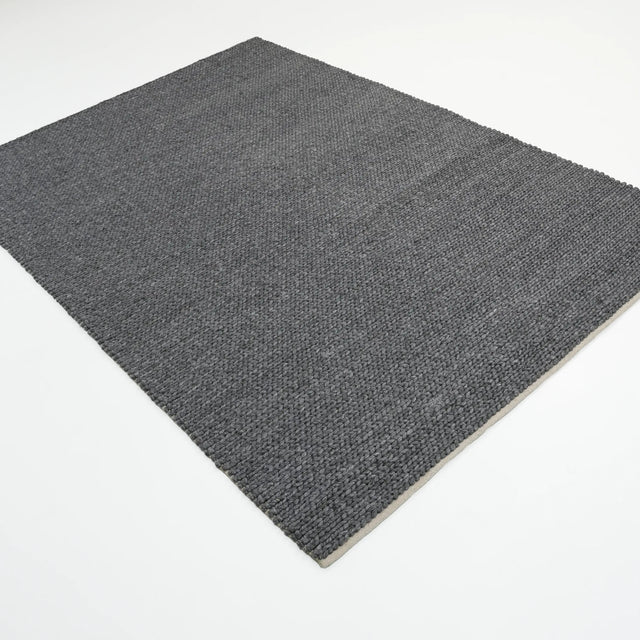 170×240 cm
Cream at 12 mm, firm rather than plush: knots you can count
 170×240 cm
Close grays spun into one yarn, wool over cotton in India
 170×240 cm
Knots tight as knitting, anthracite flecked with gray
 170×240 cm
Beige squares in a grid that drifts, wool knotted loop by loop
 170×240 cm
Ribs that run like knitted rows, three fifths of it polyester
 130×190 cm
Knots big enough to see, 2,800 grams a square meter
 100×400 cm
Eighteen millimeters deep, a white that looks knitted
 200×300 cm
Gray drifting to ivory, four parts wool to one of viscose
 90×500 cm
Beige that goes liquid across a room, viscose over wool
 300×400 cm
Eight sizes, and the same faint moiré runs through all of them
 160×230 cm
Cream heathered with gray, wool loops knotted in India
 240×340 cm
Raised loops in banded grays, 250 × 350, made in India
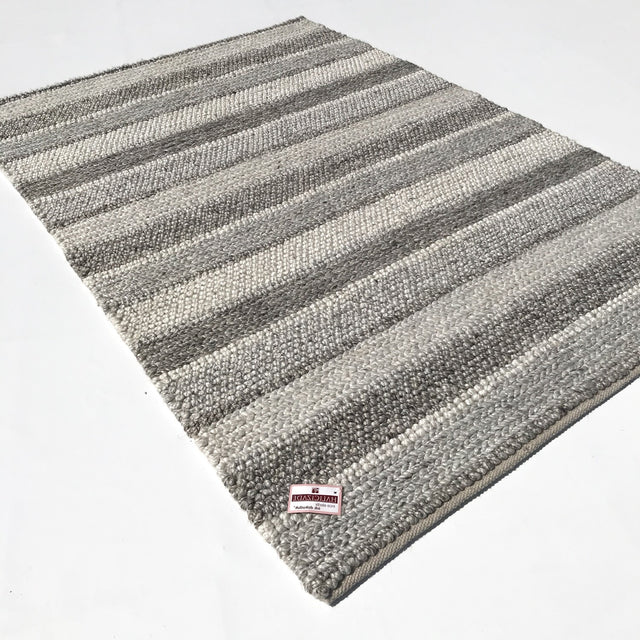 250×350 cm
Gray, and thick as a pullover: hand-knotted in five sizes
 170×240 cm
Geometry picked out in one tone of anthracite, knotted thick
 80×150 cm
Stripes you feel rather than see: cream, knotted in India
 170×240 cm
Knots as thick as stitches, cream wool out of India
 200×300 cm
Relief woven into a flat kilim, blue stepping into cream
 170×240 cm
Colors that look accidental and are not, wool on cotton
 170×240 cm
A braided rug is one whose surface is built from yarn looped or plaited into raised ridges rather than cut into a level pile, so the pattern is felt as much as seen. The texture is three-dimensional, the yarn is usually wool, and the effect is closer to a basket than to a cut pile.
Turkish calls this örgü — knitting, plaiting, braiding — and the word describes the surface rather than a region or a period. These are rugs bought for what they do underfoot and in raking light. What follows is how the structure is made, what it will and will not tolerate in a room, and what is actually in this collection.
The yarn is worked into loops and ridges as the rug is made, instead of being knotted and shorn flat.
In a knotted rug the pile is thousands of short lengths tied around the warps and then trimmed to one level, so the surface is a plane and the pattern is drawn in color. In a braided weave the yarn stays continuous: it is looped, plaited or twisted in a repeating order and worked into the ground, and the ridges it forms are the pattern. Color barely enters into it. Most of these rugs are one color, or two very close ones, and the drawing is done entirely by shadow — which is why they look different at eight in the morning than at eight at night, and why a photograph rarely does one justice.
The thick yarn also means bulk. A braided wool rug is heavy for its size and thick for its price, and it insulates a cold floor better than a thin flatweave does.
Twenty-two pieces, almost all of them handwoven wool.
The Örge Series — the name is an old Turkish word for motif — is handwoven in India to Anatolian drawing, in stripes and in patchwork-set geometry, in anthracite, gray and beige. The Nika Series is plainer: undyed cream, gray, anthracite and beige, no pattern at all beyond the braid itself. Both run 80 × 150 cm (2'7" × 4'11"), 130 × 190 cm (4'3" × 6'3"), 170 × 240 cm (5'7" × 7'10") and 200 × 300 cm (6'7" × 9'10"), with 80 × 300 cm (2'7" × 9'10") runners. The Bohem Series adds a loom-woven wool kilim at 195 × 305 cm (6'5" × 10'0"), flatter and lighter than the braided pieces. The Jade Series works the same texture in a more minimal register.
Undyed and near-undyed wool is what most of this collection is. That is worth knowing because it sets the palette: the colors are the colors sheep come in, plus a little dyeing at the gray end, and they behave in a room the way quiet, low-pattern rugs do.
One clear rule: nothing that rolls, and nothing that drags.
| Braided / looped | Hand-knotted pile | Flatweave kilim | |
|---|---|---|---|
| Surface | Raised ridges; pattern read as shadow | Level cut pile; pattern read as color | Flat, weft-faced; pattern read as color |
| Thickness and weight | Thick and heavy for the size | Medium to thick | Thin and light |
| Underfoot | Textured, springy, warm | Dense and even | Hard |
| Rolling castors | No | Tolerates it | Yes, with a mat |
| Vacuuming | Suction only, beater bar off | Beater bar off, with the pile | Suction only, both faces |
| Where it suits | Sitting rooms, bedrooms, winter gardens | Any room, long ownership | Halls, summer, layering |
Wool, worked into loops, wants a light hand.
Vacuum weekly with a soft head and the brush switched off. Blot a spill straight away with a damp cloth, pressing rather than rubbing — a raised ridge takes friction badly, and a rubbed loop fuzzes. Use a mild detergent rather than a solvent cleaner, and test it on a corner first. For a deep clean, send the rug to a washer who handles handwoven wool rugs, and say that it is a looped construction so it is not run through a brush. Rotate the rug end for end twice a year, and keep it off a spot that takes full sun all afternoon.
A braided rug is one whose surface is made from yarn looped or plaited into raised ridges rather than knotted and cut into a level pile. The pattern is a matter of texture and shadow rather than color, and the construction gives a thick, heavy fabric.
Almost all of them are wool, much of it undyed, which is why the palette runs to cream, beige, gray and anthracite. Cotton, jute, acrylic and polyester are used for braided rugs elsewhere in the market, and each changes the weight and the feel of the surface.
No. A castor run over a loop will eventually pull it, and because the yarn is continuous, one pulled loop can open a run. Use a flatweave or a dense low pile under anything on wheels, and pair a braided rug with static furniture.
Suction only, with a soft head and the rotating brush switched off, moving along the ridges rather than across them. A beater bar can catch a loop and unpick a run of the yarn in one pass, which is the most common way these rugs are damaged.
Density decides it. A tightly worked braid keeps its shape under daily traffic for years, while a loose, open braid feels softer at first and opens up sooner. Read the weave rather than the fiber when judging one for a busy room.
The handwoven wool pieces in the Örge and Nika series are made in India to Anatolian drawing, and the loom-woven Bohem kilim is woven in Türkiye. Handwork is the norm for this construction, since a continuous looped yarn is difficult to reproduce at speed.
This collection runs from 80 × 150 cm (2'7" × 4'11") up to 200 × 300 cm (6'7" × 9'10"), with 80 × 300 cm (2'7" × 9'10") runners. For a sitting room, choose a size that carries the front legs of every seat; for a bedroom, either one large piece under the bed or two mats along the long sides.
Related collections: Nika Series · Jade Series · wool rugs · calm, low-pattern rugs


