
Owned once before: a Yahyalı in red, wool down to the warp
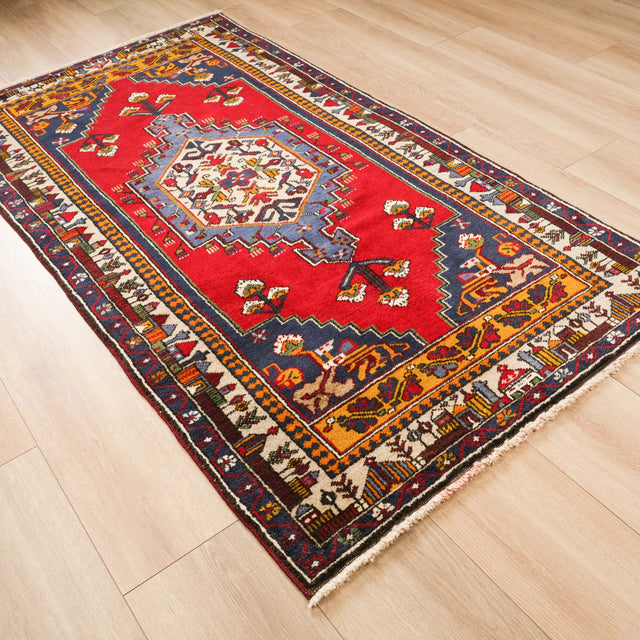 112×210 cm



Rugs & Kilims
Find Your Rug
For those who already know what they are looking for — Halıcızade's most visited collections.
Owned once before: a Yahyalı in red, wool down to the warp
112×210 cm
A Yahyalı rug is a hand-knotted wool rug from Yahyalı, a district of Kayseri in central Anatolia, woven with the symmetrical Gördes knot and colored with dyes made from local plants and earth. The tradition reaches back to the sixteenth century, the drawing is geometric, and no living creature appears in it.
Yahyalı is a village weaving rather than a workshop weaving, and almost everything worth knowing about it follows from that. The wool is spun at home, the dyes are cooked from what grows nearby, the looms run through the winter, and the standard size is the size two women can reach across. Related rugs are woven in Niğde and in Tokat under the same name.
The colors are the reason to care about these rugs. Each one comes from a named source, and the Turkish record for Yahyalı lists them plainly.
| Color | Source | How it behaves |
|---|---|---|
| Red | The root of the dye plant the weavers call boya çili — madder | Warm and brick-toned rather than scarlet; fades slowly and evenly |
| Brown | The green outer husks of walnuts | Deep and slightly olive; the most colorfast of the group |
| Olive green | Mint and water-mint leaves | Soft, grayish, never a strong green |
| Black | Spurge (sütleğen) | Used for outlines and border detail rather than fields |
| Gray | Clay mud | A mineral rather than a plant dye; muted and stable |
| White | No dye at all — the natural color of the fleece | Warms with age instead of yellowing |
A palette built this way has a narrow range and a strong internal logic, which is why old Yahyalı rugs sit together in a room even when their patterns disagree. Fold a tuft of pile back on itself to see the dye: a plant dye changes gradually along the length of the fiber, while a chemical dye is flat from tip to root. The test is set out in full in how natural and synthetic dyes are told apart.
By hand, at home, mostly by women. Fleece is worked, then spun into yarn on a çıkrık — a spinning wheel — or on a kirmen, the hand spindle that can be carried and worked standing up. Yahyalı rugs are woven in wool throughout, and the hand-spun kirman yarn is what gives the pile its slightly irregular thickness. The knot is the symmetrical Gördes knot, tied around two warp threads, which is what makes the drawing square rather than curved.
Yahyalı motifs are geometric versions of plants, objects and landscape, together with symbolic and mythological forms. What they never contain is a living creature, and that absence is the reason the group is classified in Turkish scholarship as a Classic Anatolian rug rather than a figural one. In practice it means a Yahyalı rug reads as architecture: stepped medallions, framed fields, borders that repeat a single element the whole way around.
Six named formats carry the tradition — divan, seccade (the prayer rug), yolluk (the runner), mihraplı (with a prayer niche), göbekli (with a central medallion) and dabazlı. The standard piece is about 120 × 210 cm (3'11" × 6'11"), which is why so many Yahyalı rugs are small enough to lie beside a bed or in an entry rather than under a seating group.
Weaving runs from November to May, on hand looms, worked by one or two people, with the finished rugs taken to local markets. The other destination was the dowry chest: a young woman of marrying age wove a pair of Yahyalı rugs into her trousseau. Those pairs are the reason rugs eighty years old still turn up with almost no wear — they were stored rather than used. This collection is small and holds pieces of exactly that kind, including a madder-dyed prayer rug of about 78 × 122 cm (2'7" × 4'0") at over eighty years old.
Four things, in this order. Knot density and evenness, which decide how the rug wears and how straight the pattern runs. The wool, which should feel springy and slightly oily rather than dry. The motifs, which should be symmetrical and drawn with confidence rather than copied loosely. And the dyes, since a madder red and an indigo blue hold their color for decades while a weak chemical red goes pink in a south-facing room. See Kayseri rugs for the workshop weaving of the same province and hand-knotted rugs for the wider selection.
Brush gently with a soft brush and cold water if you must clean at home, and send the rug to a professional washer for anything more. A Yahyalı rug should never go into a washing machine, which breaks down the structure and moves the color. Dry it flat in shade rather than in sun, and rotate it twice a year so that light and traffic fall on different parts of the pile.
A Yahyalı rug is a hand-knotted wool rug from the Yahyalı district of Kayseri in central Anatolia, tied with the symmetrical Gördes knot and dyed with local plant and earth dyes. The drawing is geometric, and the tradition is documented back to the sixteenth century.
Madder root for red, green walnut husks for brown, mint and water-mint leaves for olive green, and spurge for black. Gray comes from clay mud rather than a plant, and white is the undyed natural color of the fleece.
The tradition draws plants, objects, landscape and symbolic forms, but not living creatures. Because of that absence, Turkish scholarship places Yahyalı weaving in the Classic Anatolian group rather than among the figural regional traditions.
About 120 × 210 cm, or 3'11" × 6'11". The tradition also includes runners, prayer rugs with a niche at one end, medallion rugs and the divan and dabazlı formats, but the small rectangle is the standard piece.
Between November and May, on hand looms, by one or two weavers working together. The finished rugs were traditionally sold at local markets, and a young woman of marrying age wove a pair into her trousseau.
Professionally, in almost all cases. At home, use a soft brush and cold water and nothing stronger. A Yahyalı rug must not go into a washing machine, and it should be dried flat in shade rather than in direct sun.
The symmetrical Gördes knot, also called the Turkish knot, which loops around two warp threads instead of one. It holds firmly, wears evenly, and produces the angular geometric drawing that characterizes Anatolian village weaving.
Related collections: Kayseri rugs · Anatolian rugs · prayer rugs · wool rugs
