
Horses and elephants walking a red border, out of Pazyryk
 200×300 cm



Rugs & Kilims
Find Your Rug
For those who already know what they are looking for — Halıcızade's most visited collections.
Horses and elephants walking a red border, out of Pazyryk
200×300 cm
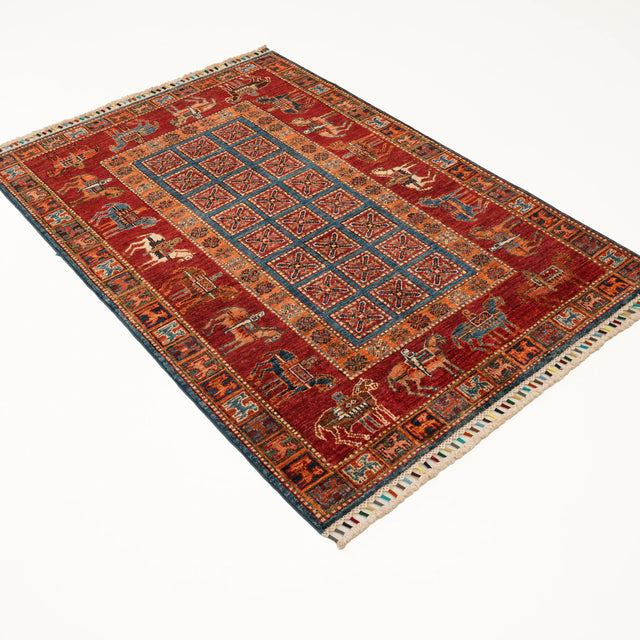 107×154 cm
One of a kind
from
29.000 TL
≈ 17.500 TL/m²
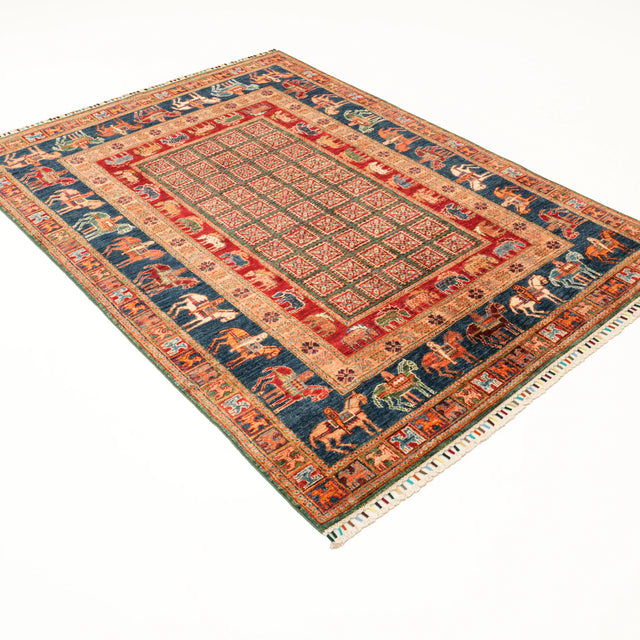 149×208 cm
One of a kind
from
55.000 TL
≈ 17.500 TL/m²
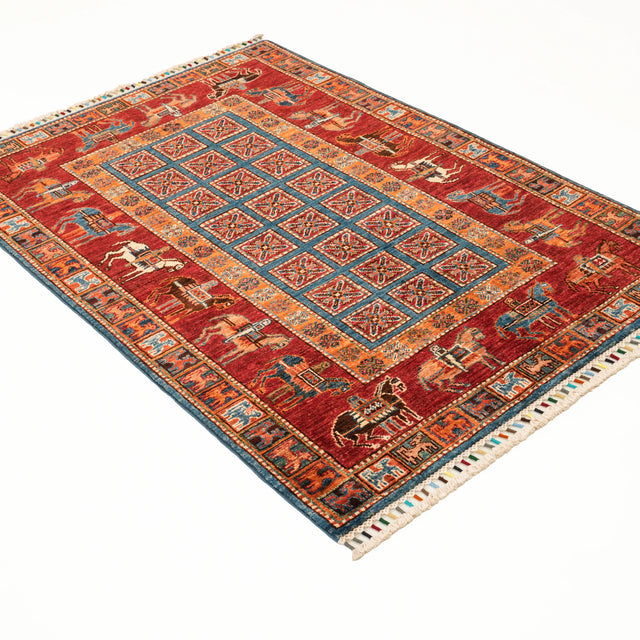 108×157 cm
One of a kind
from
30.000 TL
≈ 17.500 TL/m²
Altay kurganlarındaki 2500 yıllık halının deseni
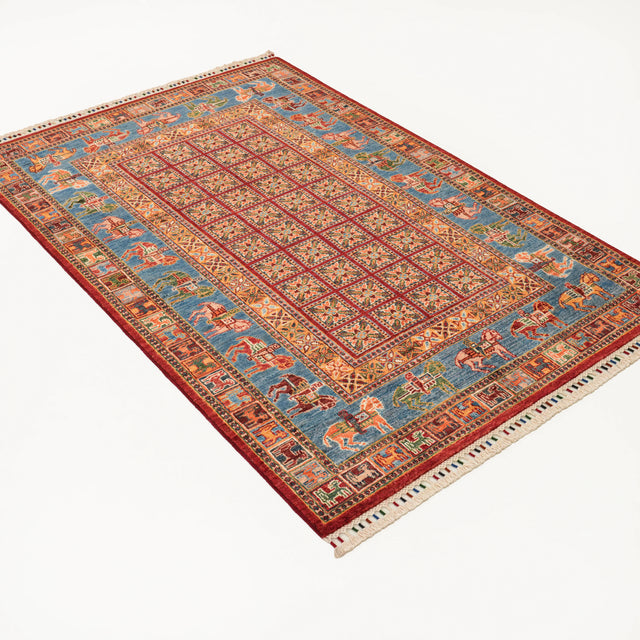 127×187 cm
One of a kind
from
42.000 TL
≈ 17.500 TL/m²
Six square meters of Pazyryk, the grid never landing twice
 201×305 cm
One of a kind
from
108.000 TL
≈ 17.500 TL/m²
Pazyryk on a grid, with the borders left full width
 169×244 cm
Animal bands round a rosette grid, 176 × 238 cm
 176×238 cm
One of a kind
from
74.000 TL
≈ 17.500 TL/m²
A grid ringed by elephants, camels and horses: Pazyryk, in wool
 240×340 cm
The Pazyryk drawing in cream Tencel®, numbered as it leaves the loom
 200×290 cm
One of a kind
from
87.000 TL
≈ 15.000 TL/m²
A Pazyryk rug is a new rug woven with the design of the Pazyryk carpet — the roughly 2,500-year-old knotted rug cut from a frozen Scythian tomb in the Altai mountains and held in the Hermitage since 1949. The original is not for sale anywhere. What is sold are reproductions and interpretations of its field and borders.
That distinction is the whole point of this page, so it is worth making twice. Nothing here is the Pazyryk carpet, and nothing here is a fragment, a copy taken from the object, or a museum-authorized facsimile. These are contemporary rugs, woven in Türkiye and in Afghanistan, carrying a design that archaeology recovered from the ice. What follows is what the original is, what a reproduction can and cannot carry over from it, and what is actually in this collection.
It is a knotted pile rug, about 183 × 200 cm (6'0" × 6'7"), and it is the oldest one that survives anywhere.
The Russian archaeologist Sergei Rudenko reached the fifth and largest kurgan of the Pazyryk valley in 1949. The tomb had been robbed in antiquity; water ran in through the robbers' breach, froze under an insulating cairn of stone, and never thawed. Wool, felt, wood and skin came out of that ice intact. The rug is knotted symmetrically at roughly 36 knots per square centimeter — a density a fine hand-knotted rug still aims at today — with a checkerboard field of twenty-four squares inside concentric borders: griffins on the narrow bands, a file of spotted antlered deer, and a band of riders and led horses whose tails are knotted. Dates given for it run from the fifth to the third century BC.
Who wove it is unresolved, and the arguments have run for seventy years. Local Scythian manufacture, an Achaemenid Persian workshop, an Armenian origin and the Central Asian nomadic tradition have all been argued from style and context, and there is no inscription to settle it. The symmetrical knot is the most-cited evidence and the weakest, since that knot was used across the whole Near and Middle East. The full account, with the dating, the excavation and the four attributions set out properly, is in the Pazyryk rug, the oldest rug in the world.
One usage note. English calls the object the Pazyryk carpet, and that phrase is used here because it is the name in the literature and in the museum label. It is the one term on this site where the word carpet stands for something that is not fitted wall to wall; everything the house sells is a rug.
It can carry the drawing. It cannot carry the object.
The composition survives translation well, because it was built to be legible at a distance: a gridded center, four concentric frames, animals in procession all facing one way. A weaver working from published photographs and drawings can set that out again on a modern loom at modern sizes, and the result looks like what it is quoting. The border discipline in particular reads exactly as it does in the Hermitage photographs.
Four things do not cross over. The format changes first: the original is nearly square, and a rug for a modern living room is not, so every reproduction stretches the field and repeats or extends the borders to fill a rectangle. The palette changes second: the original's red ground with white, yellow and blue-green comes from first-millennium-BC dyestuffs on ancient wool, read through 2,500 years of burial, and no new rug reproduces that surface. The hand changes third, since the specific irregularities of one anonymous weaver's tension and drawing are not reproducible from a photograph. And the evidentiary value — the reason anyone knows the name at all — belongs to the object in St. Petersburg and to nothing else.
What a buyer is getting, then, is a design with an unusually well-documented source, not an artifact. Read on that basis it is a good deal more interesting than most pattern names in a rug catalog.
Seven rugs, from three of the house series, in two quite different constructions.
The Şahzade Series pieces are hand-knotted in wool by Afghan weavers, with a cotton foundation, tied with the symmetrical double knot and taking months on the loom. They come in a multicolor palette across roughly 169 × 244 cm to 201 × 305 cm (5'7" × 8'0" to 6'7" × 10'0"), and each one is a single piece rather than a repeatable size run.
The Zade and Günyolu Series are loom-woven in Kütahya and Uşak in western Anatolia, on traditional looms with mechanical assistance, from cotton and Tencel yarns — Tencel being a regenerated cellulose fiber spun from wood pulp, which is why the surface shifts between matte and lit as you cross the room. Fringes are hand-knotted afterward by women in the same district. Zade carries the checkerboard field and a border of riders in red and beige, with a tree-of-life sign worked into the frame; Günyolu runs the same drawing in terra and in cream, and each rug is given its own weaving number.
| Series | Construction | Pile fiber | Sizes carried | Character |
|---|---|---|---|---|
| Şahzade | Hand-knotted, symmetrical knot, months per rug | Wool on cotton foundation | 169 × 244 to 201 × 305 cm | Dense, heavy, one-off pieces; the closest in method to the original |
| Zade | Loom-woven in Kütahya, fringes knotted by hand | Cotton and Tencel | 130 × 190 to 200 × 300 cm | Red and beige, lit surface, four sizes to a design |
| Günyolu | Loom-woven in Kütahya and Uşak | Tencel | 170 × 240 to 240 × 340 cm | Terra or cream, quieter, the largest sizes in the collection |
If the method matters more than the size, start with the hand-knotted rugs. If the room is large or light, start with the Tencel rugs.
A bordered, processional composition wants to be seen whole.
The Pazyryk drawing is a frame within a frame within a frame, and it collapses if the furniture cuts the borders. Measure for a rug that shows at least a hand's width of its outer band on every side of the seating group, or let it run past the sofa entirely rather than stopping halfway through the deer. In a smaller room the 130 × 190 cm Zade size works as a single field under a table, where the checkerboard center does the work and the borders read as an edge. The 240 × 340 cm Günyolu is the one that takes a whole seating arrangement. The same logic applies across the geometric patterned rugs, and the tree-of-life sign in the Zade frame connects it to the tree of life rugs.
The two constructions want different handling.
A hand-knotted wool rug is vacuumed in the direction of the pile with the beater bar off, rotated twice a year so light and traffic land differently, kept out of a full south window, and professionally washed every twelve to eighteen months in daily use. Tencel and viscose are regenerated cellulose: the fiber loses strength when it is wet, so blot spills immediately rather than soaking them, keep the rug off a damp floor, and send it to a cleaner who handles cellulose pile rather than washing it at home. Both benefit from an underlay, which stops the rug from creeping and takes the abrasion the pile would otherwise take.
It is the oldest knotted pile rug known to survive, recovered from the fifth kurgan of the Pazyryk valley in the Altai mountains of southern Siberia in 1949 and held in the State Hermitage Museum in St. Petersburg. It is dated between the fifth and the third century BC.
No. The original is a museum object in the Hermitage and has never been for sale. Rugs sold under the Pazyryk name are new pieces woven with the design of the original, and this collection describes them as reproductions and interpretations for that reason.
The composition: a checkerboard field of stylized cross-shaped stars inside concentric borders of griffins, spotted deer in procession, and riders with led horses. The format, the palette and the surface of the original are not reproduced, because a modern rug is rectangular, newly dyed and newly woven.
Both are made. The Şahzade Series pieces here are hand-knotted in wool on a cotton foundation with the symmetrical knot; the Zade and Günyolu Series are loom-woven in Kütahya and Uşak from cotton and Tencel yarns, with fringes knotted by hand afterward.
Roughly 2,500 years. Published dates run from the fifth to the third century BC, and the range reflects a genuine disagreement between radiocarbon results and tree-ring dating of the larch timbers used to roof the burial chambers, not a hedge.
Nobody knows. Scholars have argued for local Scythian manufacture, for an Achaemenid Persian workshop, for an Armenian origin and for the Central Asian nomadic weaving tradition. There is no inscription and no comparable dated rug, so every attribution is an argument from style and context.
Related reading and collections: the Pazyryk rug in full · hand-knotted rugs · Anatolian rugs · rare and collectible rugs


