
Four meters of sheepskin, mink-gray, no weave in it
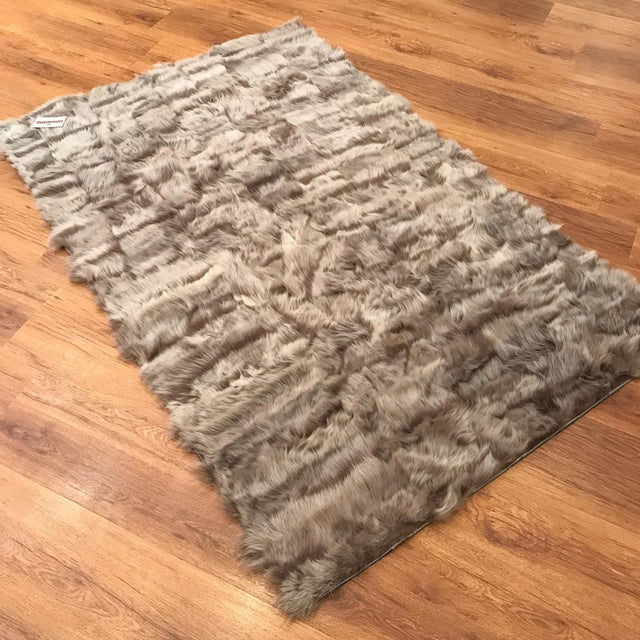 80×400 cm



Rugs & Kilims
Find Your Rug
For those who already know what they are looking for — Halıcızade's most visited collections.
Four meters of sheepskin, mink-gray, no weave in it
80×400 cm
Uncut green pile, knotted far apart, very nearly square
 190×199 cm
A shaggy rug is a long-pile rug: the yarns are long enough to lie over and tangle with one another rather than stand up as a cut plane, so the surface reads as separate strands. That depth is what makes it warm and quiet underfoot, and it is also what makes it the most demanding pile to keep clean.
The name comes straight from the English word, and the object comes from the 1960s and 1970s, when a deep tangled pile was the floor of choice and has since come back. What follows is how these are made, what the pile depth actually costs you in maintenance and in clearance, and which rooms it suits.
Long yarn, pushed through a backing, then brushed.
A row of needles punches the pile yarn into a woven ground fabric; the loops are cut and the surface is brushed out so the strands separate and stand loose. Some are heat-set afterward to hold the twist. Nothing is knotted, which is why a shaggy rug is a machine product and why it is priced as one; no hand-knotted tradition produces a pile this deep.
Fiber decides most of what follows. The Nova Series here is micro-polyester: a fine synthetic filament that is very soft in the hand, keeps color well and holds up to being washed. Acrylic imitates wool's warmth and hand and is light; polypropylene and nylon are the hard-wearing options; wool is warmer and springier and shows a footprint less. The one non-woven piece in this collection is a hide, the Toscana Series leather rug from South Africa, which is a different object with different rules — it is dry-cleaned, never wetted.
Everything good about a shaggy rug and everything difficult about it comes from the same measurement.
| Shaggy / long pile | Short pile | Flatweave | |
|---|---|---|---|
| Underfoot | Deep, soft, warm | Firm with some give | Hard; the floor is still the floor |
| Room acoustics | Absorbs footfall and echo | Some absorption | Almost none |
| Vacuuming | Suction only, slowly, often | Straightforward | Suction only, both faces |
| Door clearance | Usually will not pass | Usually passes | Passes |
| Rolling chairs | No | Marginal | Yes, with a mat |
| Shows a footprint | Yes, and it is part of the look | Slightly | No |
Nine pieces: eight machine-woven micro-polyester models from the Nova Series, made in Türkiye, and one South African hide.
The Nova models come in 80 × 150 cm (2'7" × 4'11"), 100 × 200 cm (3'3" × 6'7"), 133 × 190 cm (4'4" × 6'3"), 160 × 230 cm (5'3" × 7'7") and 200 × 290 cm (6'7" × 9'6"), with 80 × 300 cm (2'7" × 9'10") and 100 × 300 cm (3'3" × 9'10") as runners and one model cut round — see round rugs for the rest of those. Colors are the quiet end: gray, anthracite, cream, beige, brown, and a lilac and a blue for children's rooms. All of them are plain rather than patterned, which is usual for the construction: a deep tangled pile swallows drawing, so pattern is spent effort.
Rooms where people are barefoot or sitting on the floor, and where nothing rolls.
Keep it out of a full south window, rotate it end for end every six months so wear and light do not land in the same place twice, and blot spills by pressing rather than rubbing in circles. Test any spot cleaner on a corner first. Large pieces go to a professional washer; check the label before putting even a small one into a machine, since a wet deep pile is very heavy and can come out distorted.
A shaggy rug is a long-pile rug whose yarns are long enough to lie over one another rather than stand upright, so the surface reads as loose separate strands. The pile is punched into a woven backing and brushed out, which makes it soft, warm and sound-absorbing.
Use suction only and turn the beater bar off, because a rotating brush pulls long strands out of the backing. Move slowly and go over the rug more often than a short pile, since grit sinks to the base of the yarn where it cuts the fibers from below.
Usually not. A deep pile is thicker than the undercut most interior doors are hung with, and a door that scrubs across the pile wears a track in it. Measure the gap at the lowest point of the swing first, and use a flatweave in a doorway.
No. Castors sink into a long pile and the strands wrap around the axle, so the chair drags instead of rolling and the pile is damaged. Static furniture is fine; a sofa or a bed leaves a compression mark that brushes out.
Most are synthetic. The models in this collection are micro-polyester, which is soft, holds color and washes well; acrylic, polypropylene and nylon are the other common choices, and wool is warmer and springier. One piece here is a South African hide, which is dry-cleaned rather than washed.
A new cut pile releases loose fiber for the first few weeks of use, which is normal and stops on its own. Vacuum it away with suction rather than a brush head, and expect the amount to drop noticeably after the first month.
Only if the product label says so, and only in a small size. A wet deep pile holds a great deal of water and can come out of a domestic drum distorted or matted; larger pieces go to a professional rug washer, and a hide is dry-cleaned only.
Related collections: bedroom rugs · synthetic-fiber rugs · hide rugs · thin and low-pile rugs

