
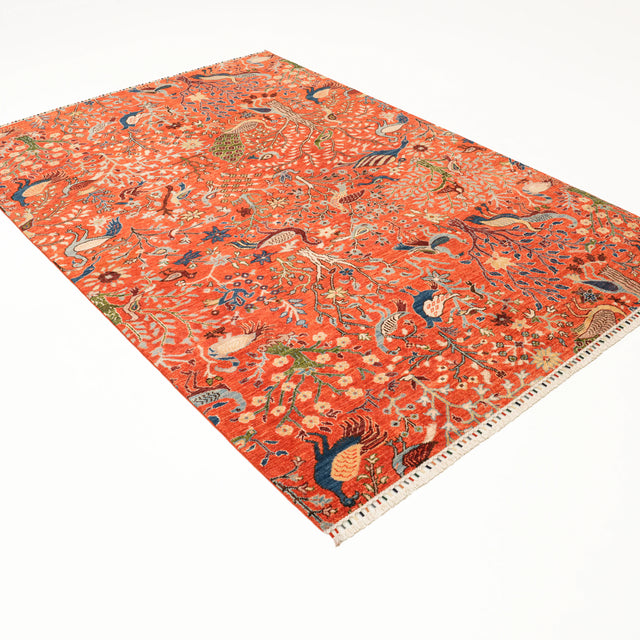
Birds and flowers at twenty knots a square centimeter, in orange
 274×357 cm



Rugs & Kilims
Find Your Rug
For those who already know what they are looking for — Halıcızade's most visited collections.
Birds and flowers at twenty knots a square centimeter, in orange
274×357 cm
Every color in it already washed back, 177 × 230 cm
 177×230 cm
One of a kind
from
94.000 TL
≈ 23.000 TL/m²
Octagons and cornered suns on navy, 280 × 360 cm of wool
 280×360 cm
Nearly six square meters of quiet, faded multicolor
 205×289 cm
Gray under Afghan flowers, and the pile is 100% wool
 153×201 cm
Birds and small animals among russet branches, on brown-mink wool
 275×360 cm
Pomegranate and ruby over mink, large flowers in the border
 269×364 cm
Oushak flowers layered on blue, two thousand knots per 10 cm²
 299×429 cm
 188×274 cm
Two thousand knots per ten square centimeters, and every color
 161×216 cm
One of a kind
from
80.000 TL
≈ 23.000 TL/m²
The Mihman Series is Halıcızade's Afghan hand-knotted line: an all-wool pile on a largely cotton foundation, tied at roughly 2,000 knots per 10 × 10 cm (about 20 knots to the square centimeter), and drawn in two families — tree-of-life compositions with peacocks and birds, and classical Oushak and Anatolian medallion patterns.
Mihman means guest, and the series earns the name on the floors people are shown first. What follows is the pattern tradition it comes out of, what its knot count actually buys, and how the two design families differ from each other and from the neighboring Şahzade line.
A trunk rises through the field and the branches fill with living things.
Peacocks drift across an orange ground; birds perch in the branches; fish and invented creatures move between the roots. Each figure keeps its own posture, so the surface reads as a narrative laid on the floor rather than as a repeating motif. This is one of the most characteristic compositions in Afghan weaving and has been passed down for generations. It survives only where the weaving is fine enough to carry it — a coarse rug turns a peacock into a smudge.
Knot count is the one objective measure of a hand-knotted rug, and figurative drawing is where it shows.
Mihman is tied at roughly 2,000 knots per 10 × 10 cm. That is one square decimeter, so about 20 knots to the square centimeter, or 200,000 to the square meter. At that density the curve of a feather, the spread of a wing and the crossing of two branches each land as a separate mark. Density does not make a rug more durable — a coarse village rug can outlive a fine one — but it does hold a drawing in register, and it keeps the pattern from softening as the pile settles over decades of use. For the wider category, see hand-knotted rugs.
Figurative on one side, classical on the other.
The figurative and floral pieces are the series at full stretch: tree-of-life compositions, birds and animals, drawing taken from nature rather than from a pattern book. The Oushak and Anatolian pieces hold to classical medallion layouts and symmetrical floral order, and read as the more formal of the two. Colors run red, navy, blue, orange, mink, yellow and green, and each color group carries its own drawing. Oushak is a weaving region in western Anatolia whose open fields and wide-set medallions have been copied for five centuries; see Oushak rugs for the originals.
Two Afghan wool series from the same house, pulling in different directions.
| Mihman Series | Şahzade Series | |
|---|---|---|
| Woven in | Afghanistan, hand-knotted | Afghanistan, hand-knotted |
| Pile | Wool throughout, cotton foundation | Wool throughout, cotton foundation |
| Knot density | Higher — about 2,000 per 10 × 10 cm | Lower |
| Drawing | Rare figurative work, tree of life, birds; plus Oushak and Anatolian medallions | Classical and ethnic layouts across a broader palette |
| Ground colors | Red, navy, blue, orange, mink, yellow, green | Turquoise, gray, orange, red, navy |
| Choose it for | A floor meant to be looked at closely | Matching a specific modern color scheme |
The Şahzade range is at Şahzade Series rugs.
The surface you stand on is wool; the structure under it is cotton.
Sizes run from about 79 x 120 cm (2'7" x 3'11") to 299 x 429 cm (9'10" x 14'1"), with runner proportions such as 80 x 300 cm (2'7" x 9'10") in between. The small pieces work beside a bed or inside a door. Around 170 x 240 cm (5'7" x 7'10") a rug will take a sofa's front legs. From 200 x 290 cm (6'7" x 9'6") upward it carries a full seating group, and the largest sizes are for rooms with the ceiling height to hold them. Because each rug is woven as one piece to its own dimensions, the numbers on the listings are rarely round.
Wool, tied dense, wants regular attention and very little intervention.
Vacuum with the beater bar off, in the direction of the pile, and rotate the rug twice a year so that sunlight and traffic move around. Wipe a spill with a damp cloth instead of scrubbing it. Deep cleaning is a job for a professional rug washer: at this density the foundation is under real tension, and a machine wash will pull it out of square.
In Afghanistan, by hand, on vertical looms. The pile is wool and the foundation is largely cotton, and a single room-size rug takes months of work at the density the series is tied to.
About 2,000 knots per a 10 by 10 cm square, which is one square decimeter, or roughly 20 knots to the square centimeter. That is dense enough to resolve a bird's feathers and the turn of a branch as separate marks rather than as a blur, which is what figurative drawing needs.
An Afghan composition in which a trunk rises through the field and birds, animals and invented creatures are set among its branches. It reads as a scene rather than a repeat, and it is the pattern the series is best known for.
Both are hand-knotted in Afghanistan with an all-wool pile. Mihman is tied denser and carries the rare figurative drawing, including the tree of life. Şahzade offers a wider spread of modern ground colors: turquoise, gray, orange, red and navy.
From about 79 x 120 cm (2'7" x 3'11") up to 299 x 429 cm (9'10" x 14'1"), including runner proportions such as 80 x 300 cm. Each rug is a single piece woven to its own dimensions, so sizes are rarely round numbers.
Red, navy, blue, orange, mink, yellow and green grounds, plus multi-color fields. The figurative designs tend toward warm grounds; the Oushak and Anatolian medallion designs run cooler and more classical.
Vacuum with the beater bar off and wipe spills with a damp cloth rather than scrubbing. A densely tied wool rug should go to a professional rug washer for deep cleaning; machine washing will distort the foundation.
Related collections: tree-of-life rugs · wool rugs · Anatolian rugs


