
Out of the chest unfaded: Taşpınar, and wool even in the warp
 154×253 cm

One of a kind
Multicolor Anatolian Hand-Knotted Wool Taşpınar Rug, Chest-Kept
from
70.000 TL
≈ 18.000 TL/m²



Rugs & Kilims
Find Your Rug
For those who already know what they are looking for — Halıcızade's most visited collections.
Out of the chest unfaded: Taşpınar, and wool even in the warp
154×253 cm
One of a kind
from
70.000 TL
≈ 18.000 TL/m²
Over seven square meters of Taşpınar wool, kept in a chest
 206×363 cm
One of a kind
from
139.000 TL
≈ 18.500 TL/m²
Taşpınar drawing, wool over wool, with abrash across it
 183×272 cm
A bolster, not a cushion: navy Taşpınar wool, 52 × 120 cm
 52×120 cm
Taşpınar navy on a cushion 120 cm long, and wool throughout
 52×120 cm
A whole Taşpınar composition inside 54 × 57 cm of wool
 54×57 cm
Navy ground for once, a red diamond at the center of it
 178×302 cm
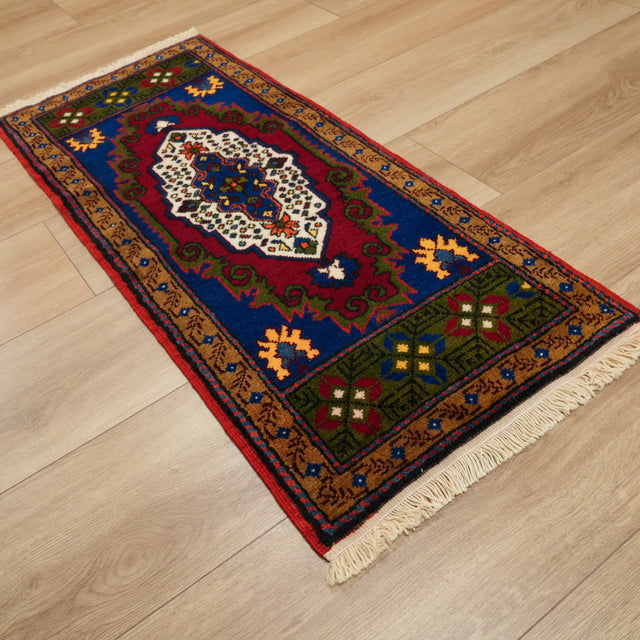
A Taşpınar rug is a hand-knotted wool rug from Taşpınar, a village in Türkiye's Aksaray province in central Anatolia. It is tied with the symmetrical Gördes knot, drawn around a large geometric central medallion in red and navy, opened up with white and cream, and bordered with vegetal motifs.
Taşpınar is the kind of hyper-local weaving tradition that makes Anatolian rug history so rich — a single village's take on a broader regional style, worth following as its own thread. Taşpınar sat in Niğde province until 1989, when Aksaray was made a province again; the rugs have been Aksaray rugs ever since.
Taşpınar's weaving history follows the broader pattern of Anatolian rug-making, where individual villages and small districts developed their own variations inside larger provincial traditions — here, within Aksaray province's central Anatolian weaving heritage. Village weaving in the district has thinned out over the past few decades, which is why old Taşpınar pieces turn up more often than new ones.
Taşpınar rugs are hand-knotted in wool with the symmetrical Gördes knot, the knot that loops around two warp threads rather than one. The field is built around a large geometric central medallion; the borders carry vegetal motifs; the ground runs red and navy, opened with white and cream. Older pieces are colored with madder and other plant dyes, though some recent weaving uses synthetic dye.
All seven Taşpınar pieces listed carry an Aksaray tag, list wool as their only pile fiber, and are hand-knotted; four of the seven are tagged as old village weaving rather than new production. The four floor sizes run 154 × 253 cm (5'1" × 8'4") to 206 × 363 cm (6'9" × 11'11"), and no two match — a hand-knotted rug leaves the loom at whatever size it leaves it. The remaining three are cushion-scale pieces. Halıcızade Halı Kilim is in Çankaya, Ankara.
This tradition's fine detail work suits traditional rooms wanting close, appreciative viewing.
| Taşpınar (Village-Specific) | General Central Anatolian Tradition | |
|---|---|---|
| Geographic specificity | Single village, Aksaray province | Broader regional category |
| Distinguishing trait | Particularly fine detail execution | Varies by specific locale |
Standard wool care applies, regular vacuuming, prompt spill treatment, and professional cleaning every 12-18 months, consistent with traditional hand-knotted construction.
A hand-knotted wool rug from Taşpınar, a village in Türkiye's Aksaray province in central Anatolia, tied with the symmetrical Gördes knot and built around a large geometric central medallion in red and navy.
Taşpınar is in Aksaray province, in central Anatolia. It belonged to Niğde province until 1989, when Aksaray was re-established as a province of its own, and the weaving is now recorded as Aksaray work.
A large geometric central medallion, vegetal borders, and a red-and-navy ground relieved with white and cream, worked at a finer count than most village weaving in the district.
Yes. All seven pieces listed here are hand-knotted in wool with the symmetrical Gördes knot, and each product page states its own fiber and dimensions.
It is the most local layer of Turkish rug heritage, where individual villages worked out their own variations inside larger regional traditions, and it disappears first when weaving stops.
Living rooms, studies and bedrooms, where the medallion can be read at close range. The cushion-scale pieces work on a bench, a divan or a floor cushion rather than underfoot.
Related collections: Anatolian rugs · hand-knotted rugs · wool rugs · vintage rugs


