
A gray frame on cream, and nothing at all inside it
 200×300 cm



Rugs & Kilims
Find Your Rug
For those who already know what they are looking for — Halıcızade's most visited collections.
A gray frame on cream, and nothing at all inside it
200×300 cm
Turquoise and gold on a cream frame, red at the center
 76×122 cm
Two meters across: black circle, silver frame, mostly viscose
 200×200 cm
Burgundy field inside a cream frame, silk and viscose over cotton
 171×243 cm
Fine flowers on cream: pearl in raking light, pastel from above
 157×243 cm
Black frame around a turquoise center: silk and viscose
 171×243 cm
Cream medallions at intervals over turquoise, viscose on cotton
 123×185 cm
Red until you are close, then a blue-green medallion
 123×183 cm
Nine parts silk, one part wool, a medallion opening in layers
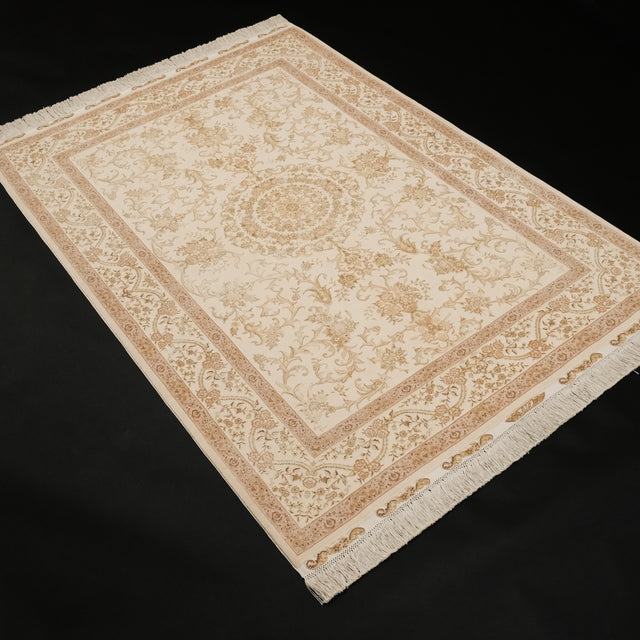 126×182 cm
One of a kind
from
148.000 TL
≈ 65.000 TL/m²
A two-meter circle, Turkmen figures cut by its own edge
 160×160 cm
Bestseller
from
20.500 TL
≈ 8.000 TL/m²
Two diameters, 160 and 200 cm, and gray stripes on both
 200×200 cm
Ninety percent silk, ten percent wool, and no longer being woven
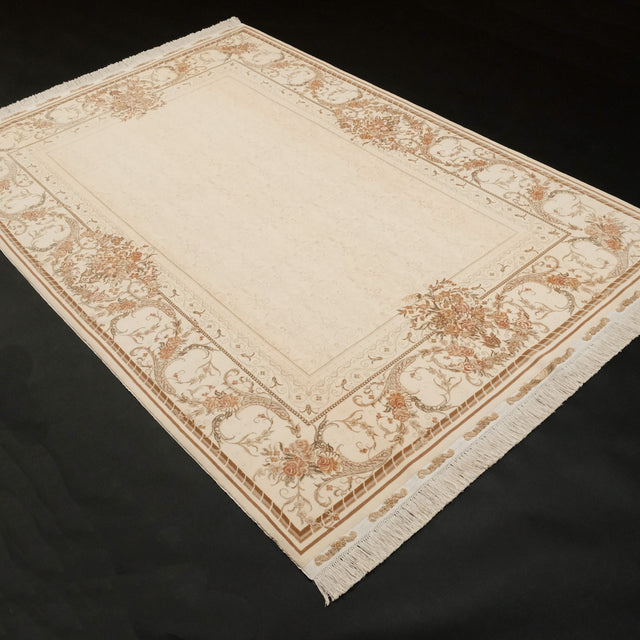 162×240 cm
Blue medallion in a 196 cm circle, its relief cut by shears
 196×196 cm
One of a kind
from
96.500 TL
≈ 25.000 TL/m²
Gold and blue over cream: viscose, knotted in China
 169×240 cm
Beaten hard in the Bijar manner: burgundy on a floral field
 201×247 cm
Spun on a kirmen spindle, colored out of plant roots
 162×252 cm
A palace drawing on navy, a hundred reeds of cotton and viscose
 240×340 cm
Lilac to purple, carved in relief, round at 150 and 200 cm
 200×200 cm
Cream and gold at the same value, the drawing carried by sheen
 172×222 cm
One of a kind
from
134.000 TL
≈ 35.000 TL/m²
Silk in the motifs, wool underfoot, 177 × 234 cm
 177×234 cm
One of a kind
from
145.000 TL
≈ 35.000 TL/m²
Anthracite gray; the quarter that is not silk is Erzurum wool
 250×312 cm
One of a kind
from
470.000 TL
≈ 60.000 TL/m²
Silk warp, silk weft, silk pile: cream inside red borders
 171×242 cm
The Hereke drawing scattered small, on silk in dark red
 170×251 cm
Cream and gold swapping places along the pile: 100% silk
 207×303 cm
A bordered rug features one or more distinct decorative frames surrounding a central field, a structural pattern convention used across most traditional Turkish and Persian weaving to visually contain and emphasize the rug's central motif.
The border isn't just decoration around the edge — it's a structural design element that shapes how the entire rug's composition reads, and that framing function is worth understanding on its own.
Nearly all traditional Turkish and Persian rug design is organized around a bordered structure, one or more concentric frames enclosing a central field, a convention with roots stretching back centuries across nearly every major regional weaving tradition.
A rug's border typically echoes or complements the central field's motifs at a smaller, more repetitive scale, creating visual rhythm while clearly separating the rug's central focus from its edge, a compositional principle distinct from an all-over or borderless pattern.
We maintain traditional bordered composition across much of our pattern-forward catalog because this framing structure is fundamental to how classical Turkish rug design organizes visual weight and hierarchy.
A clearly bordered rug works especially well when its edges remain visible within the room's layout.
| Bordered Rug | Borderless / All-Over Pattern | |
|---|---|---|
| Structure | Central field framed by distinct border | Pattern repeats edge to edge |
| Visual hierarchy | Clear focal center | More uniform, textural |
| Traditional use | Classical Turkish/Persian convention | More common in modern, geometric design |
Standard wool care applies, regular vacuuming, prompt spill treatment, and professional cleaning every 12-18 months; rotate periodically to ensure the border wears evenly on all sides.
The border is a foundational design convention in Turkish and Persian rug weaving, framing and emphasizing the central field, with roots stretching back centuries.
Typically yes, the border often echoes or complements the central field's motifs at a smaller, more repetitive scale, creating visual rhythm.
Sizing the rug so furniture sits within the central field, leaving the border visible around the seating area, generally preserves the intended framing effect.
No, our modern and Scandinavian-design collections often use borderless, all-over patterns, while our traditional pattern-forward catalog maintains classical bordered composition.
Traditional and formal living rooms and dining rooms suit bordered composition particularly well, given its classical, structured character.
Furniture that echoes the border's color generally complements the rug better than furniture competing directly with the central field's main motif.


