
Birds at rest in gold branches over a gray Tencel® ground
 240×340 cm



Rugs & Kilims
Find Your Rug
For those who already know what they are looking for — Halıcızade's most visited collections.
Birds at rest in gold branches over a gray Tencel® ground
240×340 cm
Wool for the matt ground, Tencel® for the birds
 240×340 cm
Two knockers, one deep and one shrill: wool does the weathered wood
 200×300 cm
Plank grain and one iron ornament, mink Tencel® over cotton
 200×300 cm
Sundown in an Erzincan gorge, gold and beige in Tencel®
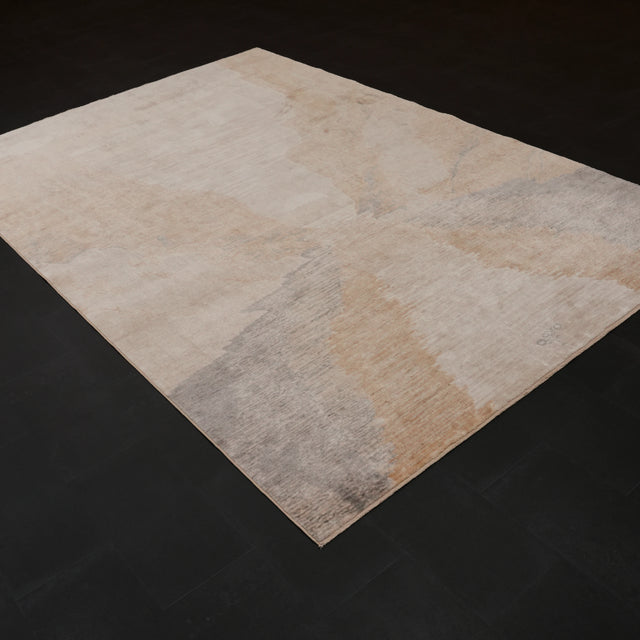 200×300 cm
The Dark Canyon of Kemaliye: wool for rock, Tencel® for water
 200×300 cm
Wool takes the terracotta, Tencel® takes the gray
 200×300 cm
Gray Tencel®, and the light coming from one corner only
 200×300 cm
Distressed beige under three Mamluk medallions, pile of Tencel®
 200×300 cm
Three Mamluk octagons, terracotta into gray, wool with Tencel®
 200×300 cm
Hereke, Oushak and Kayseri drawing, split across three grounds
 200×300 cm
The Pazyryk drawing in cream Tencel®, numbered as it leaves the loom
 200×290 cm
One of a kind
from
87.000 TL
≈ 15.000 TL/m²
A grid ringed by elephants, camels and horses: Pazyryk, in wool
 240×340 cm
Salmon and orange wake a faded gray, wool with Tencel®
 300×390 cm
Flowers at low contrast on mink, Tencel® over cotton
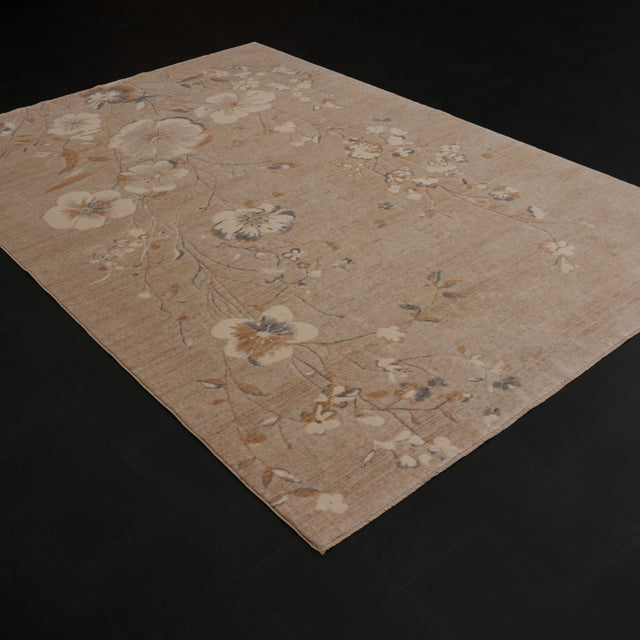 200×300 cm
Wool and Tencel®: flowers off symmetry, one bird in the corner
 200×300 cm
The pattern only shows when you crouch, pastel on mink Tencel®
 300×390 cm
The Günyolu Series is Halıcızade's loom-woven line: a cotton foundation carrying Tencel and wool, woven on the traditional upright looms of Kütahya and Uşak and finished by hand. The palette runs gray, cream, beige, mink and terra, and the series takes its name from a mountain village in Kemaliye, in Erzincan province.
Günyolu sits between two things a buyer usually has to choose between: the surface of hand work and the dimensional consistency of a loom. This page covers how that weave is made, what the colors do beside real furniture, which fibers are used in which model, and the eighteen designs currently woven in the series.
The kara tezgah is the traditional upright loom of Anatolia. The knots are tied by the loom; the finishing — edges, selvedge, fringe — is completed by hand. In a hand-knotted rug every knot is tied individually, one rug takes months, and the price follows the labor.
You can tell them apart by touch. On the back of a loom-woven rug the rows of knots run straighter than on a hand-knotted one. On the face the difference narrows, and the edges give it away in the other direction: because the finishing is hand work, the selvedge and fringe do not have the cut regularity of a factory rug. The same weave underlies the Zade Series and the Zima Series; the three differ in pattern, not in structure. For the technique across the whole store, see loom-woven rugs.
Gray dominates the series, with cream and beige behind it and mink and terra as the warm end.
Gray's job on a floor is to retreat. The furniture comes forward and the rug holds still beneath it, which is the opposite of what a strongly colored rug does. The undertone is what decides the fit: oak and walnut both carry a yellow-red undertone, so a cool gray beside them reads as deliberate contrast, while a warm gray — one with beige in it — sits down beside the same wood without argument. Against linen and bouclé upholstery a gray ground makes the weave of the fabric visible; under a dark leather sofa a pale gray defines the piece without adding weight. Mink and terra are the intermediate step for a neutral room that wants color but not a strong one.
Several models in the series are distressed on purpose. Copper and earth-toned marks are spread across the ground, sections of the pattern are opened out, and the rug looks aged from the first day.
The reason is as practical as it is visual. A new rug with sharp color transitions has to negotiate with every object in the room; a worn-looking ground is more forgiving and does not argue with what is set beside it. Distressing also brings forward the natural fading that would arrive anyway, so the rug looks much the same in five years as it does now. None of it is accidental — where the ground opens and where each mark falls is decided at the design stage.
Both fibers appear in the series, and most models use them together over a cotton foundation.
Tencel is a regenerated fiber made from wood cellulose in a closed-loop solvent process, in which most of the solvent is recovered; it is a brand name, and the generic term is lyocell. In a rug it does two things. It breaks light the way silk does, so the same gray ground looks different in the morning and in the evening, and it gives a cool, fluid surface rather than the warmth of wool. Where wool is used, that reverses: matte, firm and warm underfoot.
The honest limitation is that Tencel weakens when it is wet. Spills should not be left standing and the rug should not be left damp. Which yarn is in which model is stated on the product page. Compare Tencel rugs and wool rugs.
The designs are drawn for Halıcızade, and the sources are Anatolian.
Every design in the series carries the tree of life, Halıcızade's signature figure — one of the oldest motifs in Anatolian weaving, drawn with its roots underground and its branches in the sky, and read as the continuation of a line. It marks the rug as a house design rather than grading it. Other pieces carrying the same mark are gathered under tree of life rugs.
Most designs are woven in more than one size, so a pattern can usually be had in the dimension a room needs.
| Size | Imperial | What it suits |
|---|---|---|
| 90 × 150 cm | 2'11" × 4'11" | An entrance, a bedside |
| 90 × 190 to 90 × 590 cm | 2'11" × 6'3" to 2'11" × 19'4" | Corridors, including runs over five meters |
| 130 × 190 cm | 4'3" × 6'3" | A small room, under a single chair |
| 170 × 240 cm | 5'7" × 7'10" | A bedroom, a compact sitting room |
| 200 × 290 and 200 × 300 cm | 6'7" × 9'6" and 6'7" × 9'10" | A standard three-and-two seating group, front legs on |
| 240 × 340 cm | 7'10" × 11'2" | An L-shaped unit, or all legs on in a large room |
| 300 × 390 cm | 9'10" × 12'10" | An open-plan room with the seating floated |
The long runners are the unusual part. Ready-made corridor rugs above five meters are scarce, and the series is woven to 590 cm. In a corridor, the right length leaves 15 to 20 cm (6 to 8 in) of floor at each end so the rug repeats the line of the passage instead of butting into the walls, and at least 10 cm (4 in) of floor visible along each side. See also hallway runners.
Because the finishing is done by hand, the edges may not run exactly parallel and one end can be a couple of centimeters wider than the other. On fringed models the tassels are not identical in length. A row of pattern may shift by a millimeter or two. All of this comes from the tension of the loom and is left uncorrected; not every piece shows it, and some weave up perfectly straight.
Tencel's sheen changes with the light, so the tone in a showroom and the tone at home will not be identical, and the ground will darken and lighten as the rug is turned. That is how the fiber breaks light, not a color fault.
Günyolu is Halıcızade's loom-woven series, built on a cotton foundation with Tencel and wool, woven on the traditional upright looms of Kütahya and Uşak and finished by hand. Its palette runs through gray, cream, beige, mink and terra, and every design carries the tree of life.
On a loom-woven rug the loom ties the knots and the finishing is completed by hand. On a hand-knotted rug every knot is tied individually, which takes months for a single rug and is priced accordingly.
Most models use both over a cotton foundation. Tencel is a regenerated wood-cellulose fiber that breaks light like silk and feels cool underfoot; wool is matte, firm and warm. The product page states which yarn is used in each design.
Because a worn-looking ground argues less with the rest of a room than a sharply new one does, and because it brings forward the fading that would arrive anyway. The distressing is designed rather than random: where the ground opens and where each mark falls is decided in advance.
From 90 × 150 cm up to 300 × 390 cm, with runners woven in 90 cm widths at lengths from 150 cm to 590 cm. Most designs are woven in more than one size, so a pattern can usually be had in the dimension a particular room needs.
Vacuum in the direction of the pile and lift spills immediately with a dry cloth rather than rubbing them in. Tencel weakens when wet, so the rug should not be left damp, and a full wash belongs with a professional rug washer rather than at home.
Related collections: Zade Series · Zima Series · Tencel rugs · hallway runners


