
Anatolian motifs a half-tone under the beige, sharpening by lamp
 300×390 cm



Rugs & Kilims
Find Your Rug
For those who already know what they are looking for — Halıcızade's most visited collections.
Anatolian motifs a half-tone under the beige, sharpening by lamp
300×390 cm
Mink ground, New Zealand fleece, blue and red and olive
 200×300 cm
Brown shapes loose on cream, nothing repeating anywhere
 160×235 cm
Gold and blue over cream: viscose, knotted in China
 169×240 cm
Beige over mink: the fine kind of Oushak drawing
 250×350 cm
Wool in the foundation as well, Oushak flowers in gray and mink
 300×400 cm
Scandinavian lines in mink, and the rush throws its own shadow
 120×180 cm
Beige leaning to mink, with a border to hold it
 300×400 cm
Round, cream to beige, dense viscose in three diameters
 200×200 cm
Turquoise and mustard blocked over mink, double-knotted
 147×202 cm
Vintage drawing worn into mink, woven at a hundred reeds
 300×400 cm
Marble veins in cream and beige, machine-woven at 100 reed
 300×400 cm
Four meters of sheepskin, mink-gray, no weave in it
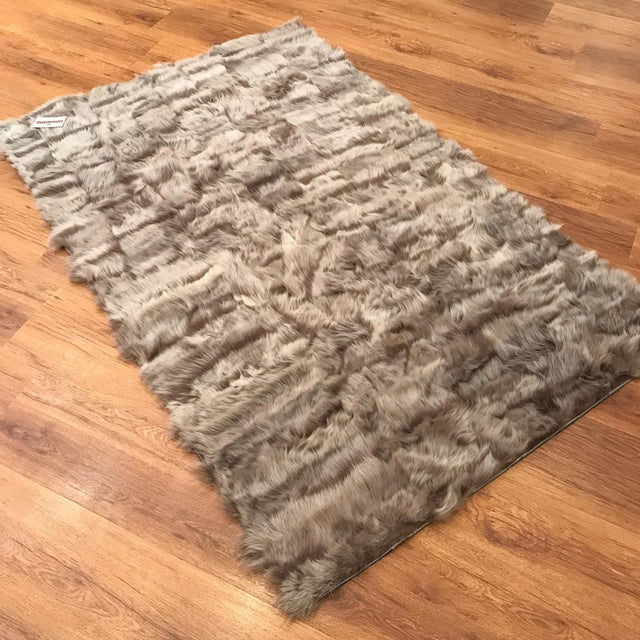 80×400 cm
Moiré through the mink, in Tencel® from Kütahya
 260×370 cm
Five rings of hide, each a different skin, darkening inward
 190×230 cm
Squares of South American hide, mink gray-brown throughout
 200×240 cm
Copper heaped at one end, thinning out into cream: Tencel®
 200×300 cm
One of a kind
from
90.000 TL
≈ 15.000 TL/m²
Each one carries a weave number, cream easing out to gray
 300×390 cm
Plank grain and one iron ornament, mink Tencel® over cotton
 200×300 cm
Gold and gray cracks netted over mink, fringes braided by hand
 200×300 cm
Distressed beige under three Mamluk medallions, pile of Tencel®
 200×300 cm
Copper glints rising out of mink, and no wool in it
 300×390 cm
Beige with one pale disc widening in it, Tencel® on cotton
 240×340 cm
The pattern only shows when you crouch, pastel on mink Tencel®
 300×390 cm
A mink rug — vizon in Turkish, taupe or greige in English — sits in the narrow band between gray and beige, warmer than gray and cooler than sand. In hand-knotted work the tone often comes from undyed brown and gray fleece carded with ivory, or from walnut husk and oak gall, Anatolia's commonest brown dyes.
Mink is the neutral that survives a change of sofa. What follows is where the color actually comes from, how it behaves under a lamp against north daylight, and the one thing it does badly.
Often from no dye at all.
Sheep are not one color. A weaver working from natural fleece can card pale gray or light brown wool together with ivory and spin a yarn that lands, without any dye bath, exactly in the greige range — which is why undyed rugs from Anatolia so often read as taupe rather than as cream. Where dye was used, the browns came from walnut husk (Juglans regia), which gives a warm mid-brown and needs almost no mordant, and from oak gall and other tannin sources, which give cooler grays and browns and turn nearly black with iron. A madder red saddened with iron lands in the same neighborhood from the red side.
On the loom-woven and machine-woven side the color is engineered rather than found: Tencel, bamboo viscose and heat-set synthetics are dyed to a specified taupe, and the sheen of those fibers makes the tone read lighter at one end of the rug and darker at the other. Undyed wool has no sheen and no such directionality, which is the quickest way to tell the two apart across a room.
Greige is a balance between a warm and a cool component, and any light source tips it.
Under domestic lamplight at roughly 2700 K, which is heavy in red and orange, mink moves toward beige and can pick up a distinctly pink-brown cast — flattering with oak, walnut and brass, less so beside a cool gray sofa it was chosen to match. Under north-facing daylight near 6500 K the same rug moves the other way, toward gray, and against a warm wall it can look faintly green. This is the reason a taupe rug that looked right in the shop sometimes reads wrong at home: nothing is faulty, the light has simply changed which half of the color you are seeing.
The practical rule is to decide which half you want. If the room's fixed elements are warm — oak floor, brass, terracotta — pick a mink on the gray side, and the room will pull it warm. If the fixed elements are cool — pale concrete, gray tile, steel — pick a mink on the beige side. Choosing a taupe that already matches the sofa under showroom light almost always produces a rug that looks slightly wrong at home.
Less than any other pale color, with one real exception.
Vacuum without the beater bar and in the direction of the pile, and have a hand-knotted wool piece professionally washed every twelve to eighteen months in daily use. How a rug is cleaned covers the rest.
| Construction | How the color reads | Weight and feel | Best for |
|---|---|---|---|
| Hand-knotted wool | Matte, slightly uneven, often undyed | Dense and heavy, deep pile | Living rooms and bedrooms meant to be kept for years |
| Loom-woven Tencel and bamboo viscose | Sheen; lighter from one end, darker from the other | Even, medium weight, soft | Low-traffic rooms where the light on the floor matters |
| Machine-woven viscose blend | Uniform, consistent across sizes | Light to medium, flat profile | Corridors, offices, large floors on a set budget |
| Flat-woven kilim and jute | Matte, flecked, texture over color | Thin, light, reversible in a kilim | Layering, balconies, winter gardens, summer months |
| Cowhide and sheepskin | Natural markings rather than a single tone | Thin, irregular outline | Accent under a chair; dry cleaning only |
The mink selection here runs across all five: hand-knotted Anatolian-pattern wool in the Şahzade Series, loom-woven Oushak drawing in the Tempus Series, Tencel and viscose in the Zima Series, and cowhide.
Mink, or taupe, sits between gray and beige — warmer than gray and cooler than sand. Designers often call the same band greige. In a rug it is frequently not dyed at all but spun from naturally brown and gray fleece carded with ivory.
Both, depending on the light. Under household lamplight near 2700 K it reads beige and can look faintly pink-brown; under north-facing daylight near 6500 K it reads gray and can look faintly green against a warm wall.
Better than any other pale neutral. Ordinary household soil is itself a gray-brown, so it disappears into the tone rather than sitting on top of it, which is why taupe survives in corridors and entries where cream does not.
In a cut pile with sheen, such as viscose, bamboo viscose or Tencel, sections of pile can settle permanently in a different direction and reflect light differently. The patches look like water marks but are a characteristic of the fiber, not soil.
Almost all of them, which is the point. Oak and walnut, cream, anthracite, olive, navy and brass all sit on it comfortably. The one thing to decide first is whether the room's fixed elements are warm or cool, then choose a mink leaning the other way.
Less than most colors. Undyed wool has no dye in it to lose, and tannin-based browns from walnut husk and oak gall are relatively stable in light, so taupe holds up in bright rooms where a red or a purple would drift.
Related collections: cream rugs · gray rugs · brown rugs · plain-color rugs


