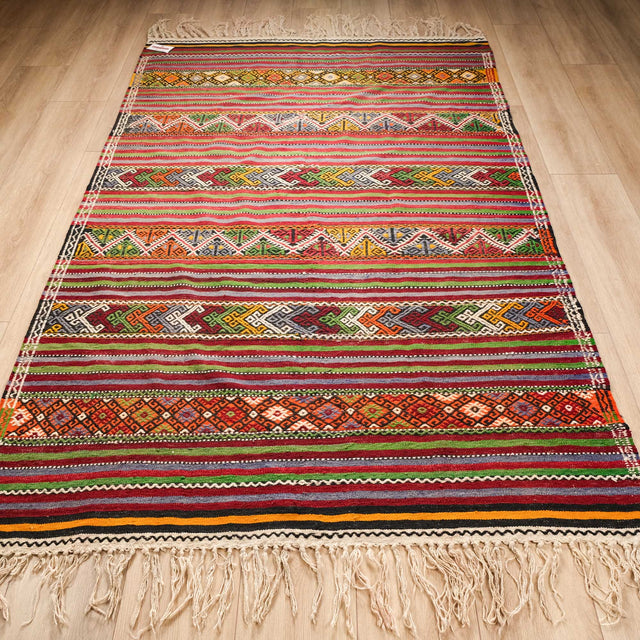
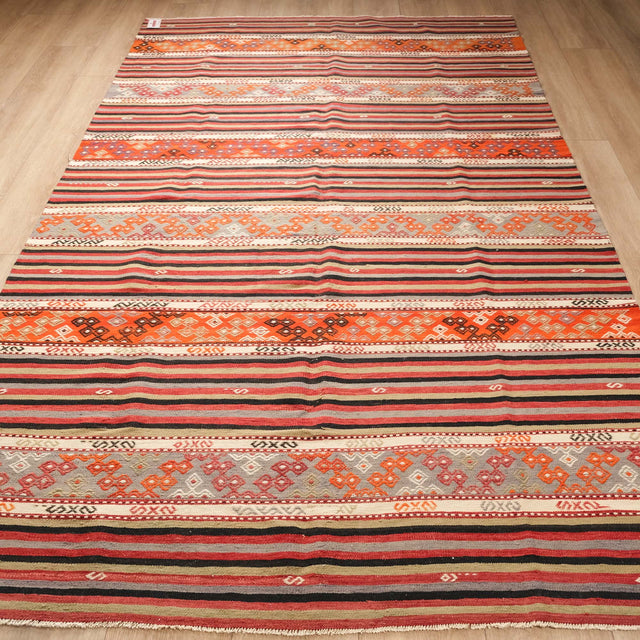
Wool cicim from Mut, its motifs raised off the ground
 103×141 cm

One of a kind
Multicolor Anatolian Handwoven Wool Cicim Kilim, Mut Yörük
from
26.000 TL
≈ 18.000 TL/m²



Rugs & Kilims
Find Your Rug
For those who already know what they are looking for — Halıcızade's most visited collections.
Wool cicim from Mut, its motifs raised off the ground
103×141 cm
One of a kind
from
26.000 TL
≈ 18.000 TL/m²
Star ranks brocaded over orange, root-dyed wool from Fethiye
 127×176 cm
Kozak cicim above Bergama, wool from end to end
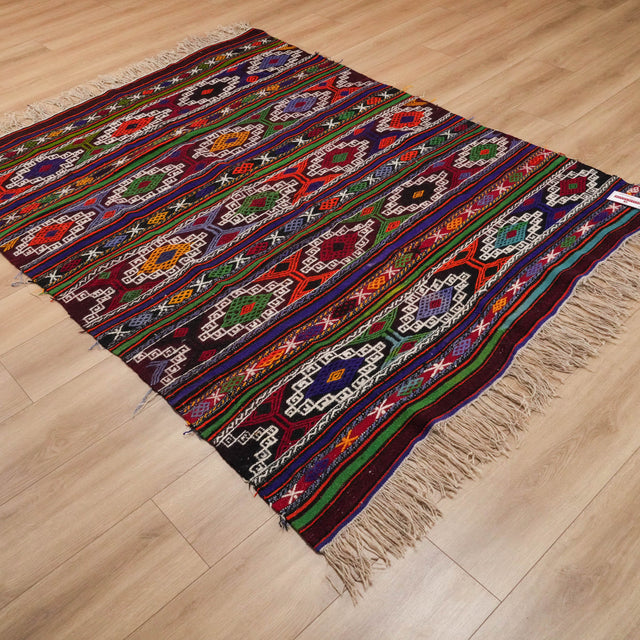 171×231 cm
Wool over cotton on a Konya village loom, 95 × 130 cm
 95×130 cm
Denizli's Çal district, cicim brocade raised off the weave
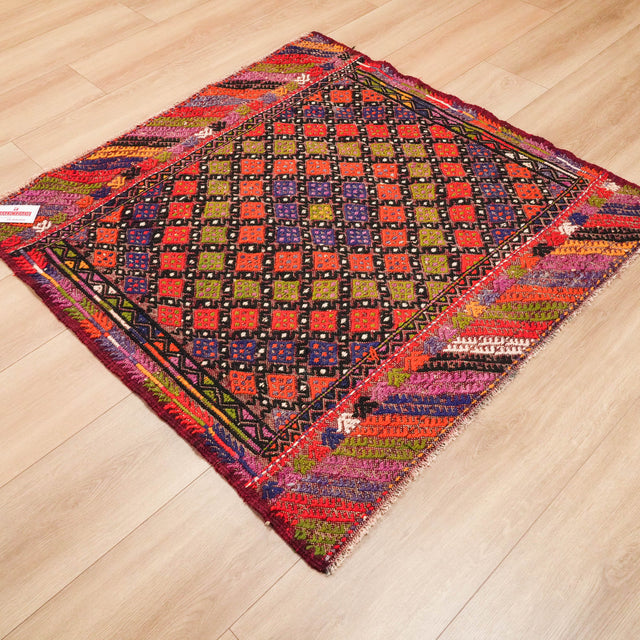 126×130 cm
Cicim from Antalya: the wool figures stand above the ground
 163×300 cm
Motifs you feel before you see them: cicim wool, nearly four meters
 161×392 cm
A saddlebag, not a rug: wool cicim from a dowry chest
 50×133 cm
Sixty-one centimeters wide, a Mut cicim, wool throughout
 61×110 cm
Village-woven in Balıkesir: burgundy cicim, wool end to end
 158×234 cm
Balıkesir wool, Selendi drawing, 192 × 246 cm unfaded
 192×246 cm
Near-square at 142 × 166 cm, the shape a round table wants
 142×166 cm
Selendi cicim, 118 × 170 cm: cotton for line, wool for color
 118×170 cm
Secondhand, and already broken in: 167 × 238 cm of wool cicim
 167×238 cm
Corridor width in cicim: black ground, motifs in added yarn
 96×250 cm
Green ground, Helvacı motifs standing off it in wool
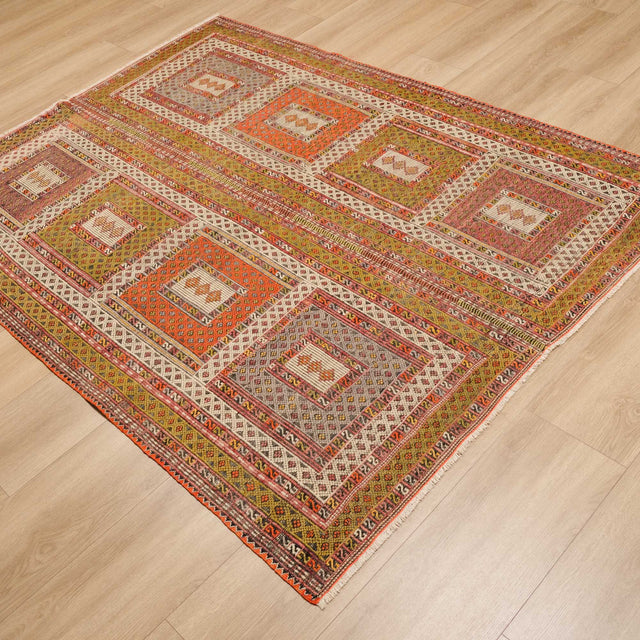 156×206 cm
Half a century folded away: Burdur cicim, 196 × 354 cm
 196×354 cm
Burdur cicim in wool: orange leading, green and red behind
 114×161 cm
Orange over everything, and the motifs raised in wool
 160×280 cm
A salon-sized cicim, banded in red and green, never used
 206×312 cm
Bands instead of a medallion: a Çanakkale kilim, all wool
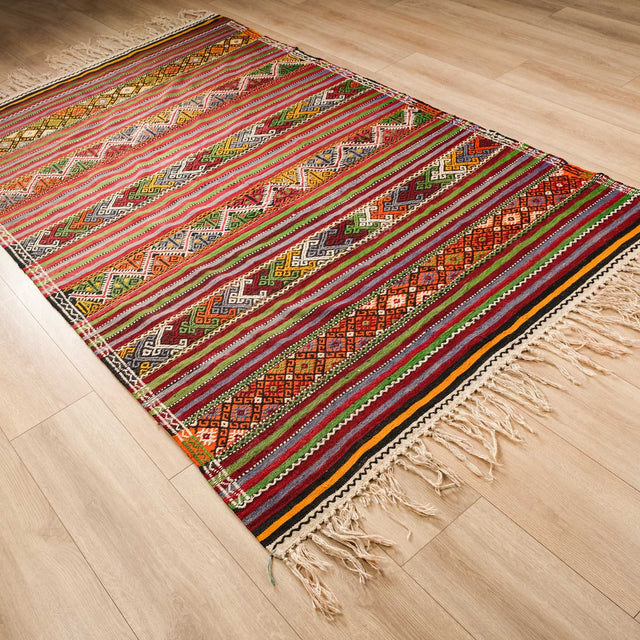 156×258 cm
Forty-eight by ninety-seven centimeters of Karapınar cicim
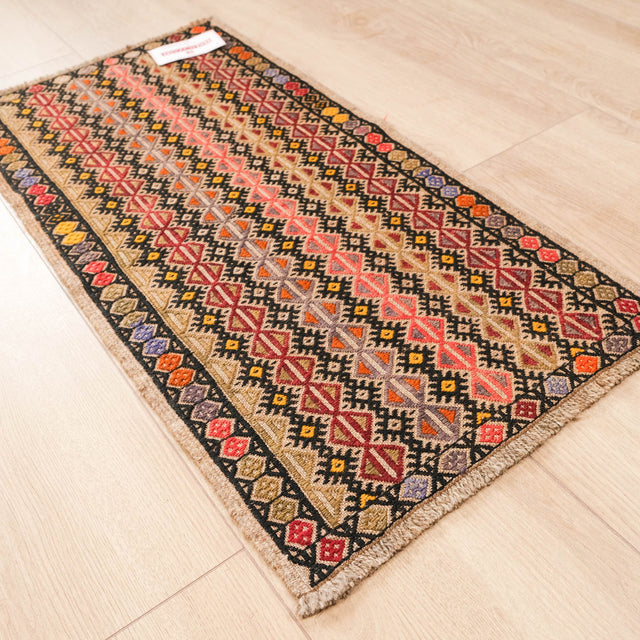 48×97 cm
Two to one: 161 × 313, wool brocade over cotton warps
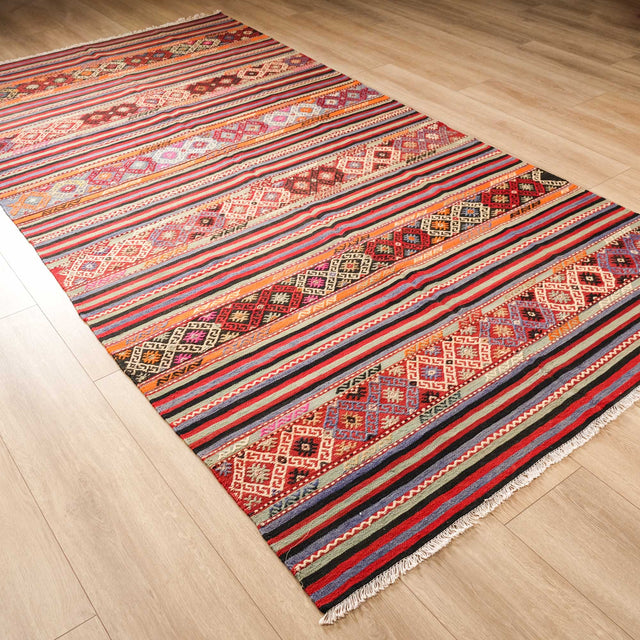 161×313 cm
Cicim carried across six square meters, warm orange underneath
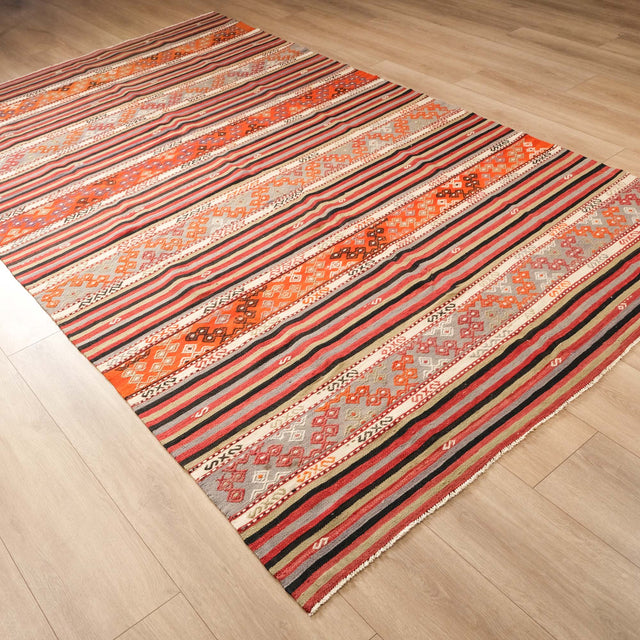 183×315 cm
A cicim is an Anatolian flatweave in which extra colored wefts are laid over a plain woven ground as the weaving proceeds, so that the motifs sit slightly proud of the surface and read like needlework. The ground weave holds the fabric together; the cicim yarn carries nothing but the pattern.
Everyday Turkish calls almost any pileless weaving a kilim. The workshop does not, and the difference is structural rather than decorative. This page sets out what the cicim technique actually does at the loom, how it differs from plain kilim, from zili and from sumak, which parts of Anatolia weave it, and what the twenty-seven pieces in this collection are.
It is a supplementary weft technique, which means the pattern yarn is structurally optional.
Start with the ground. The warps are strung on the loom under tension; a plain weft goes over and under them, row after row, and that fabric would hold together perfectly well on its own. Cicim adds a second, thicker, differently colored yarn that travels across the same shed but does not do the fabric's work. It floats over two warps and drops behind the next, or over three and behind the next, and it is those float lengths — two-span and three-span cicim, in the weaver's own terms — that set how dense and how fine the resulting motif is. Every few rows the whole surface is beaten down with the kirkit, the heavy toothed comb.
Two consequences follow. The motif stands above the ground, so the fabric is not flat and the two faces are not the same. And the motif is not bound by the slit that governs classic kilim drawing, so cicim figures can be smaller, denser and less rigidly stepped than the ones a slit-weave kilim can hold. A complicated piece is sometimes worked by two weavers rather than one, with the second sitting behind the loom to arrange the pattern yarns while the first follows the drawing on the face.
Four pileless techniques, one loom, one comb, and four different routes for the patterning yarn.
| Technique | How the pattern is made | Surface | Traditionally used for |
|---|---|---|---|
| Kilim | The colored wefts themselves interlace with the warps and turn back at each color change, leaving a slit | Flat; both faces identical | Floor spreads, wall panels, prayer kilims |
| Cicim | Extra yarns are laid over a plain ground weave as it proceeds, floating over two or three warps | Motifs stand slightly raised on a visible ground, like embroidery | Covers, cushions, small spreads, dowry pieces |
| Zili | Pattern yarns float across the entire surface in a regular two-over-one or three-over-one step | Ribbed and linear over the whole field | Spreads, cushions, storage sacks |
| Sumak | Pattern yarns are wrapped around the warps instead of passed between them | Dense, braided, chain-like and very hard-wearing | Saddlebags, grain sacks, spreads |
The short version: a kilim is woven, a cicim is laid on, a zili floats and a sumak is wrapped. Village weavers combine two or three of them in a single piece as a matter of course, which is why a fair number of the flatweaves in the wider handwoven kilim range carry cicim bands across an otherwise slit-woven field.
Across most of Anatolia, with the strongest traditions in the south and the west.
Gaziantep, Siirt, Silifke, Kırşehir, Karaman and Sivas are the districts most often named for cicim work, and the pieces here bear that out while widening it. The collection includes weavings from Mut and Karapınar on the Konya plain, from Konya itself, from Balıkesir and its villages at Selendi, Helvacı and Kozak, from Çanakkale, and from Burdur, Fethiye, Antalya and Çal in the southwest. Regional habit is real but modest: the Antep pieces run to bright color and hard geometry, the southeastern ones to denser and more crowded motifs, the central Anatolian ones to earth tones. A weaver in one valley draws the ram's horn slightly differently from the woman two valleys over, and that is most of what regional attribution amounts to.
The motif vocabulary itself is shared with the rest of Turkish flat weaving — the hands-on-hips elibelinde, the ram's horn, the eye, the hook, the tree of life, birds and deer, and a set of figures whose received meanings were assembled by twentieth-century collectors rather than recorded from weavers. That whole question is worked through in kilim motifs and their meanings.
Mostly not the floor.
Because the raised motif is the point, cicim was woven for things that were seen close up and handled: covers for a chest or a bed, cushion faces, small spreads, curtain panels for the wall of a room, and the two-pocket saddlebag called a heybe that hung over an animal or a shoulder. This collection contains one such heybe, at 50 × 133 cm (1'8" × 4'4"). Many pieces were dowry weaving — made by a young woman for her own household, folded into a chest, used a few times and folded away again. The Turkish trade calls those sandık eskisi, chest-aged, and the phrase describes the condition exactly: soft at the folds, unworn in the middle, the colors still where they started because nothing bleached them.
Used on the floor today, a cicim behaves like any flatweave — thin, light, reversible enough to turn, easy to lift and shake out — with the one caveat that a raised float can catch. It belongs beside a bed, under a coffee table, in a hall, layered over boards or over a larger rug, or on a wall, which is where the technique reads best.
Twenty-seven pieces, all handwoven in wool, and every one of them is a single item rather than a size that can be reordered.
They run from 48 × 97 cm (1'7" × 3'2"), a small mat, up to 206 × 312 cm (6'9" × 10'3"), with a group of long narrow weavings around 160 × 300 cm (5'3" × 9'10") that work as runners. Most are older village weavings rather than new production, several are recorded with madder and other natural dyes, and a number carry the abrash that follows when a weaver moves from one dye lot to the next mid-piece. On the house's age convention — antique is 100 years or more, semi-antique 50 to 100, vintage 20 to 80, and the rest new — these sit mainly in the vintage and semi-antique bands. Those are trade terms in ordinary commercial use, with no issuing authority behind them and no certificate attached.
Turn it over. On a genuine cicim the pattern yarn is visible on the back as loose floats and loops crossing the ground weave, which is the plainest evidence that the motif was laid on rather than woven in. Then check four things.
Cleaning is hand work. Vacuum gently and without a beater bar, in the direction of the floats rather than against them, blot spills rather than rubbing them, and send anything more than that to a washer who handles handwoven wool flatweaves. Dry flat and out of direct sun.
A cicim is an Anatolian flatweave in which extra colored wefts are laid over a plain woven ground while the weaving proceeds, so the motifs sit slightly raised on the surface and look embroidered. The ground weave holds the fabric together and the cicim yarn carries only the pattern.
In a kilim the pattern is made by the structural wefts themselves, so the fabric is flat and both faces look the same. In a cicim the pattern is made by extra yarns laid over a ground weave that is already complete, so the motifs stand proud and the back shows loose floats.
All three lay a pattern yarn over a ground weave. Cicim floats it over two or three warps in discrete motifs, zili floats it across the whole surface in a regular repeat to give a ribbed field, and sumak wraps it around each warp to give a dense braided face used for saddlebags and sacks.
Across Anatolia, most often in Gaziantep, Siirt, Silifke, Kırşehir, Karaman and Sivas. The pieces in this collection come from Mut, Karapınar and Konya on the central plain, from Balıkesir, Selendi, Helvacı, Kozak and Çanakkale in the west, and from Burdur, Fethiye, Antalya and Çal in the southwest.
Yes, and it always was in part. A cicim is thin, light and easy to lift, which suits a bedside, a hall, a layer over boards or a spot under a table. The raised floats can catch, so it is not the right choice for a doorway or a chair that is pushed back and forth.
Vacuum gently with the beater bar off, moving in the direction of the floats rather than against them, and blot spills instead of rubbing them. Anything beyond that goes to a washer who handles handwoven wool flatweaves by hand. Dry the piece flat and out of direct sun.
Look at the back. A handwoven cicim shows the pattern yarn as loose floats and loops crossing a visible ground weave, with small irregularities in the drawing and in the color between dye lots. A machine-made imitation has a uniform backing and repeats its motifs identically down the field.
Related reading and collections: kilim motifs and their meanings · handwoven kilims · Anatolian kilims · rare and collectible pieces