
Anatolian cicim, wool and cotton, the motifs raised off the weave
 186×277 cm



Rugs & Kilims
Find Your Rug
For those who already know what they are looking for — Halıcızade's most visited collections.
Anatolian cicim, wool and cotton, the motifs raised off the weave
186×277 cm
Wool wrapped, not knotted: a soumak past eighty years
 172×263 cm
Denizli Çalçırpı kilim, wool throughout, ninety centimeters wide
 90×268 cm
An Oushak kilim rather than an Oushak rug, chest-kept wool
 117×167 cm
Karakeçili saddlebag in wool: two pockets on one strip
 50×141 cm
Turquoise instead of the usual red, 90 × 118 cm of wool
 90×118 cm
Brown into terracotta: the color the fleece came in
 113×171 cm
Hooked geometry drawn light on red, 110 × 167 cm in wool
 110×167 cm
Multicolored figures stacked in rows, 108 × 170 cm, wool throughout
 108×170 cm
A flatweave with wool in its warp, never quite square
 140×176 cm
Stepped diagonals from İnlice, wool woven over cotton
 139×185 cm
An Eşme kilim that spent its life folded, wool throughout
 84×133 cm
Wool cicim from Mut, its motifs raised off the ground
 103×141 cm
One of a kind
from
26.000 TL
≈ 18.000 TL/m²
Wool on wool, no pile: an Eşme kilim woven at home
 84×133 cm
Anatolian motifs flat-woven in Mut, wool right through
 88×129 cm
Six colors in stacked bands, half a meter of Afghan wool
 50×50 cm
Village color at full strength, no pile anywhere in it
 50×50 cm
One of a kind
from
2.800 TL
≈ 11.000 TL/m²
Orange leading, blue cooling: a kilim cushion for the floor
 50×50 cm
One of a kind
from
2.800 TL
≈ 11.000 TL/m²
Root-dyed reds, blues and yellows, a kilim 77 cm wide
 77×102 cm
Star ranks brocaded over orange, root-dyed wool from Fethiye
 127×176 cm
Van at the eastern edge, angular wool with no curve in it
 106×144 cm
Narrow bands keep the colors from arguing: İnlice wool
 114×185 cm
Navy cicim at 47 × 102 cm, sized for a wall
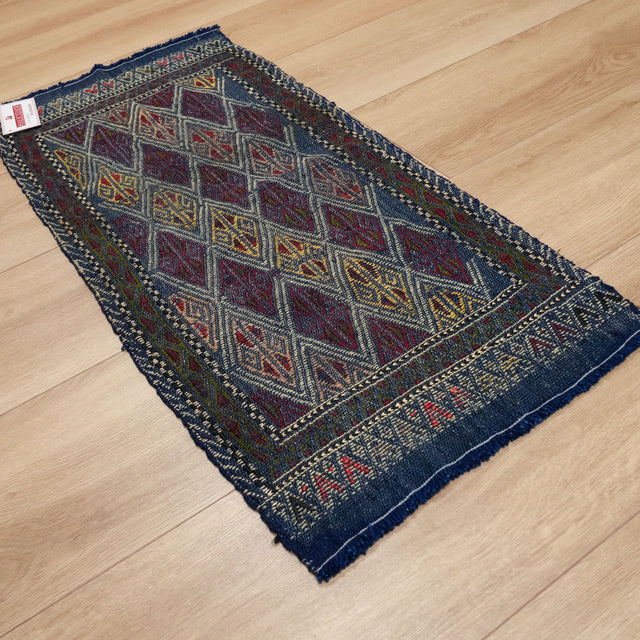 47×102 cm
Mut, under the Taurus: wool both faces, 97 × 212 cm
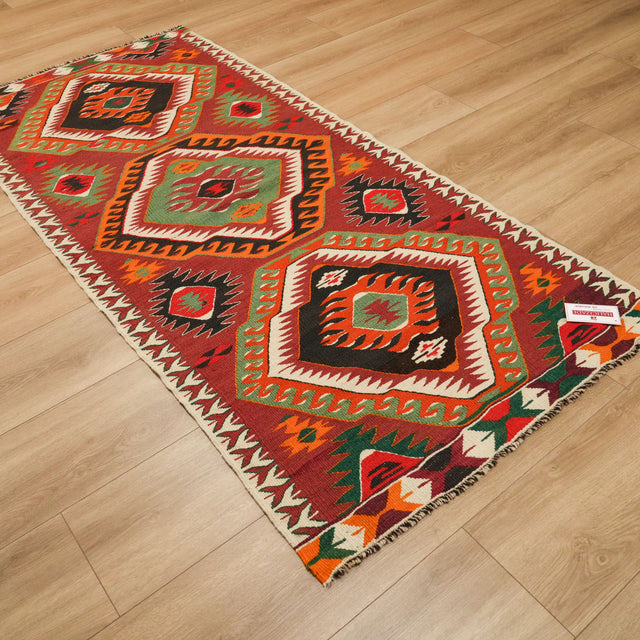 97×212 cm
An Anatolian kilim is a flat-woven rug from Anatolia with no pile: the pattern is built by the weft itself, packed tight enough to bury the warp, so the piece is thin, light and reversible. Kilims are woven in wool, dyed with madder and indigo, and drawn in geometric motifs that change from district to district.
Anatolia has no single kilim. It has several hundred village traditions, each with a palette, a motif set and a weave structure of its own, and the good ones are cataloged by village rather than by style. This page covers how a flat weave is actually constructed, what separates the four main techniques, which districts to look for, and what the motifs meant to the women who wove them.
Two sets of threads, and only one of them shows. The warp runs the length of the loom under tension and ends as the fringe. The weft is beaten down across it so hard that the warp disappears — the term is weft-faced — and every shape in the design is made by turning a colored weft back at the edge of its own area. Where two colors meet along a vertical line, that turn leaves a small slit in the fabric, which is why the classic Anatolian kilim is called a slit-weave.
Nothing is knotted, so a kilim has no pile, no nap direction and no right side: the back is as finished as the front. It is thin enough to layer over a larger rug or over boards, light enough to hang, and quicker to weave than a knotted rug, which is reflected in what it costs.
Four flat-weave techniques circulate under the general word kilim, and they are not the same thing.
| Technique | How it is made | How to recognize it | What it suits |
|---|---|---|---|
| Kilim (slit-weave) | Weft-faced plain weave; colors turn back at the edge of their own area | Small vertical slits along the color joins; identical on both faces | Floors, layering, wall hanging |
| Cicim (also cecim) | Extra wefts brocaded over a plain-woven ground | The motif sits slightly proud of the surface, like embroidery that is woven in | Small decorative pieces, cushion faces, hangings |
| Sumak | Wefts wrapped around pairs of warps rather than passed straight through | A fine diagonal ridge on the face, loose weft ends on the back | Hard-wearing floor pieces, bags |
| Kıl kilim | Woven from goat hair rather than sheep's wool | Coarser, stiffer, with a distinct sheen | Heavy use, entries, tent and floor covering traditionally |
Most collections mix them, and a single piece may combine two — a slit-woven ground with cicim brocading in the panels is common in Yörük work. Compare handwoven kilims with flat-woven rugs to see the range, or machine-woven kilims if the budget rather than the provenance is the constraint.
Naming a kilim by its village is the whole discipline. Eşme, in Uşak province, weaves in soft reds and worn pinks. Konya has three separate traditions in Obruk, Akören and İnlice, all of them large-scale and boldly drawn. Mut, in the Taurus, is Yörük work in strong red and dark blue with brocaded panels. Van and Hakkari, in the far east, weave dark, dense pieces at high weft counts. Fethiye and Kaş Barak, on the Mediterranean, use more orange and more white. Denizli's Çal weavings and Manisa's Selendi and Karakeçili work run to narrow formats and running borders.
The list is long — Sivas, Kayseri, Afyon, Bayat, Balıkesir Yüncü, Bergama Kozak, Aksaray Sultanhanı, Şarkışla, Elmadağ, Ereğli, Malatya, Erzurum Bardız, Adana Bahçecik, Hatay Reyhanlı, Çanakkale, Ağrı — and it is worth reading the district name on a listing before the color. Two kilims that look alike in a photograph can come from traditions eight hundred kilometers apart.
Kilim motifs are a written language that stopped being read as writing. The two most common are the elibelinde, a stylized female figure with hands on hips that stands for motherhood and fertility, and the koç boynuzu, the ram's horn, which stands for strength. Around them run the smaller marks — the hook, the comb, the eye, the running water — each with a meaning that traveled from mother to daughter. Every district drew them slightly differently, which is how a kilim can be placed by motif as well as by palette. The full vocabulary is set out in kilim motifs and their meanings.
Look at the back first: on a good kilim the design is as sharp behind as in front, and the weft is packed evenly with no gaping between color areas. Then count the wefts over a few centimeters. A denser weave is a heavier, longer-lasting piece and it holds a straight line better. Check the fiber — wool should feel springy and faintly oily rather than dry — and check the dyes by folding a thread back on itself, since a plant dye grades along its length while a chemical dye is flat from end to end. Finally, match the format to the job. This collection runs from 50 × 50 cm (1'8" × 1'8") cushion faces and a Yörük saddlebag through village pieces of about 77 × 102 cm (2'6" × 3'4") up to room pieces of 186 × 277 cm (6'1" × 9'1"), with narrow weavings around 90 × 268 cm (2'11" × 8'10") that work as hallway runners.
Shake a kilim out or brush it gently with a soft brush rather than running a beater bar over it. Deal with a spill immediately. A full wash belongs with a professional; done at home it means cold water, a mild natural soap, no hard scrubbing, and drying flat in shade rather than in sun, since direct light is what moves the color. Because a kilim is reversible, turning it over once a year distributes wear across both faces — a small habit that adds years to a thin weaving.
An Anatolian kilim is a flat-woven rug from Anatolia with no pile. The pattern is made by the weft itself, packed tightly enough to hide the warp, so the piece is thin, light and reversible, and it is normally woven in wool with plant dyes.
A knotted rug has a pile of cut yarn tied around the warps, so it is thick, heavy and one-sided. A kilim has no knots and no pile: the weft builds the pattern directly, which makes it thin, reversible and faster to weave.
Kilim is weft-faced plain weave with small slits where colors meet. Cicim adds extra wefts brocaded over a plain ground, so the motif sits slightly proud. Sumak wraps the weft around pairs of warps, leaving a diagonal ridge on the face.
The elibelinde is a stylized female figure with hands on hips and stands for motherhood and fertility. The koç boynuzu, or ram's horn, stands for strength. Both are drawn slightly differently in every weaving district.
By palette, motif and weave density together. Eşme weaves soft reds, Konya works large and bold, Mut uses strong red and dark blue with brocaded panels, and Van and Hakkari weave dark pieces at high weft counts. The district name on a listing is the first thing to read.
Wool is standard for the pattern wefts, on a wool or cotton warp. Goat hair is used for the coarser kıl kilim, and cotton appears as a white highlight. The dyes are traditionally madder, indigo and other plant sources.
Shake it out or brush it gently with a soft brush, and treat spills at once. A deep clean should go to a professional washer; at home use cold water and a mild natural soap without scrubbing, then dry the kilim flat in shade.
Halıcızade Halı Kilim in Ankara buys Anatolian kilims by district, and names the district on the listing wherever it is known.
Last updated: 10 September 2026
Related collections: handwoven kilims · modern kilims · Anatolian rugs · Turkish rugs


