296 cm of corridor, a different district in every panel
 82×296 cm

One of a kind
Multicolor Patchwork Handwoven Wool Runner, Anadolu Şal Series
from
88.000 TL
≈ 36.000 TL/m²



Rugs & Kilims
Find Your Rug
For those who already know what they are looking for — Halıcızade's most visited collections.
296 cm of corridor, a different district in every panel
82×296 cm
One of a kind
from
88.000 TL
≈ 36.000 TL/m²
A corridor of wool panels, each one a different figure
 80×290 cm
One of a kind
from
84.000 TL
≈ 36.000 TL/m²
Sixty centimeters wide and one of one: wool patchwork runner
 65×172 cm
A cream border set with red and green medallions, wool on cotton
 200×300 cm
Blue, red and orange flowers over gray, on an Aegean loom
 300×400 cm
Burgundy under gold flowers, silk and viscose, knotted in China
 89×180 cm
Burgundy for 485 cm, tied dense enough to lie flat
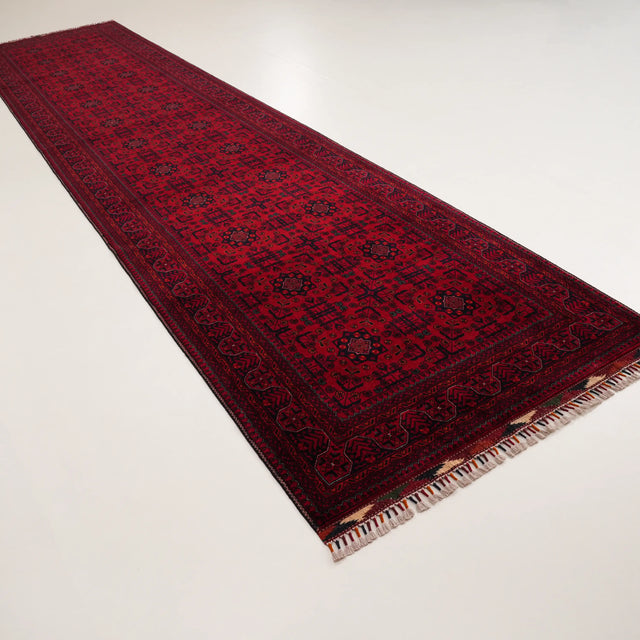 108×485 cm
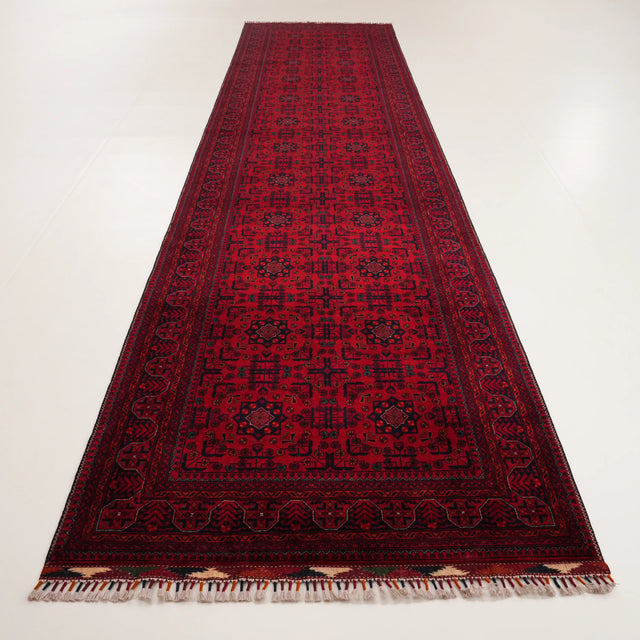
86 cm wide and three meters long, burgundy Turkmen work
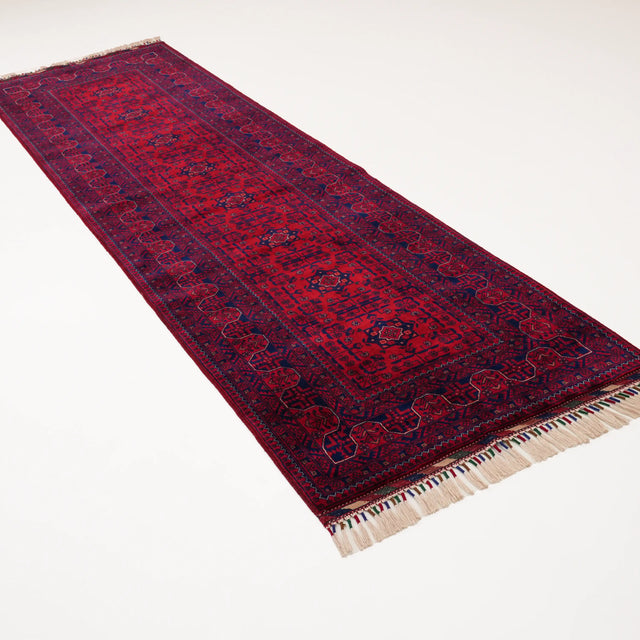 86×302 cm
One of a kind
from
52.000 TL
≈ 20.000 TL/m²
Navy figures repeating on burgundy, three meters of corridor
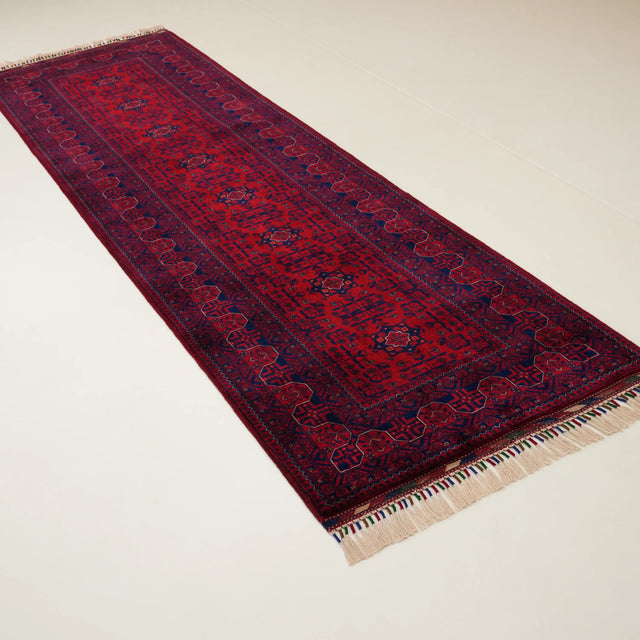 86×309 cm
Denizli Çalçırpı kilim, wool throughout, ninety centimeters wide
 90×268 cm
Three meters of Yağcıbedir, wool pile over a wool warp
 84×300 cm
Geometry on cream: wool matt, bamboo viscose brighter
 240×340 cm
Deep navy frames the brights, gray cooling the two edges
 84×309 cm
One of a kind
from
94.000 TL
≈ 36.000 TL/m²
Pomegranate red into olive, then night blue, band by band
 85×304 cm
One of a kind
from
94.000 TL
≈ 36.000 TL/m²
A yellow ground, burgundy and navy bands stacked up it
 85×301 cm
One of a kind
from
93.000 TL
≈ 36.000 TL/m²
Bands of green, red and blue across three meters of wool
 85×301 cm
One of a kind
from
92.000 TL
≈ 36.000 TL/m²
Silk lit against black wool, a drawn frame, 83 × 293 cm
 83×293 cm
One of a kind
from
36.500 TL
≈ 15.000 TL/m²
Wool spun on a kirmen, dyed with roots, worn eighty years
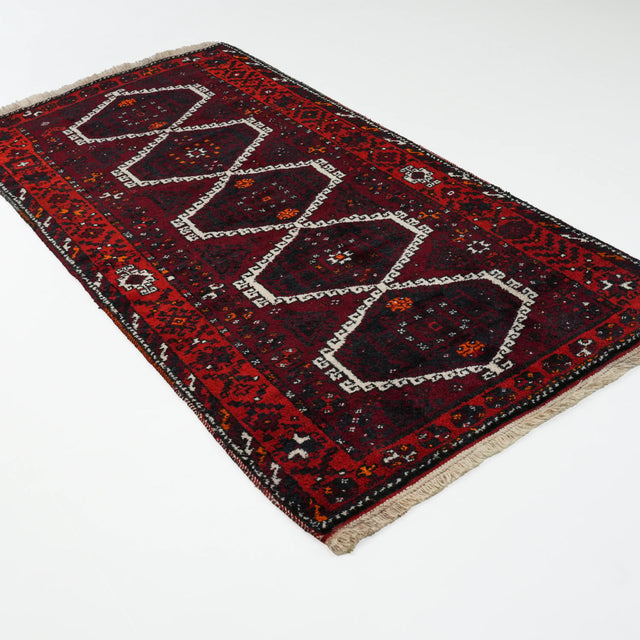 126×243 cm
Sand beige, Gabbeh figures in four colors, colored fringes
 230×330 cm
Green, red and blue placed by eye on yellow, wool right through
 230×330 cm
Gabbeh figures on a night blue, and the fringes are dyed too
 230×330 cm
Gabbeh figures set symmetrically, 100% wool, red into burgundy
 200×300 cm
Chest-kept Herki runner, orange shifting batch by batch
 80×346 cm
Burgundy on cotton, four weeks of knotting to the square meter
 87×296 cm
One of a kind
from
52.000 TL
≈ 20.000 TL/m²
A runner is a rug woven long and narrow for a corridor, entrance hall or landing, standard widths of 80, 90 and 100 cm and lengths from 140 to 500 cm. Handwoven runners come in one-off sizes instead — 76 × 310, 84 × 302, 88 × 336 cm — because each is cut from its own warp rather than to a size chart.
A corridor is the one floor in a house where the rug's proportions matter more than its pattern, because you see it end-on and lengthwise, never from a chair. What follows is how to size a runner against the width you have, what the different constructions do underfoot, and the two places a runner meets architecture — a door leaf and a flight of stairs.
One rule decides it: floor should show at both sides. A runner that reaches wall to wall reads as fitted carpet gone wrong — carpet being the word for the wall-to-wall kind, and the only place it is used here; a runner with stone or board visible along each edge reads as a rug.
Leave 10–20 cm clear on each side of the runner, and 30–40 cm of bare floor at each end of the corridor. In practice that means a 100 cm corridor takes an 80 cm runner and a 120 cm corridor takes a 100 cm one. Measure the narrowest point of the passage, not the widest — a corridor that opens out halfway along still has to let the runner past the pinch.
Length comes in bands, and the store's stock groups into five of them:
For a corridor longer than five meters, lay two runners of the same design end to end and leave roughly 20 cm between them. The gap is not a compromise. It shows the floor, breaks the length into readable sections, and gives you a place to stand while you shake one out.
They come in dimensions. A handwoven runner is a single piece off a single loom, so its width and length are whatever that warp and that weaver produced: 76 × 310, 82 × 296, 84 × 302, 85 × 301, 88 × 336, 100 × 335, 108 × 485 cm. None of those is a mistake, and none of them will ever be restocked.
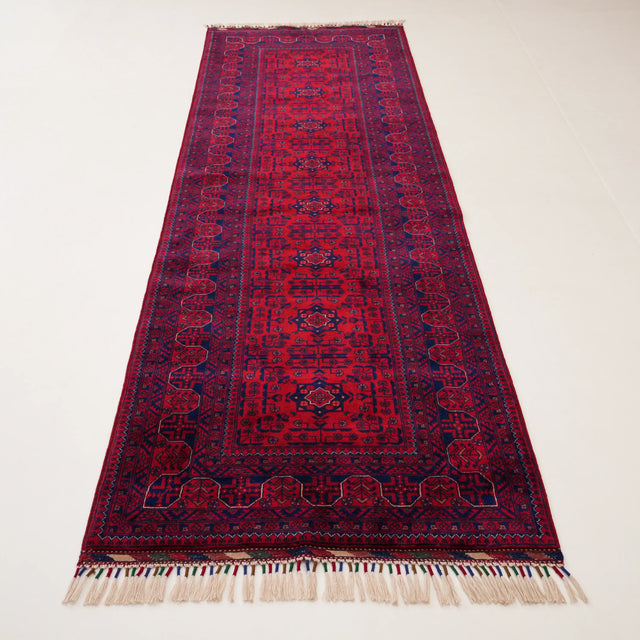
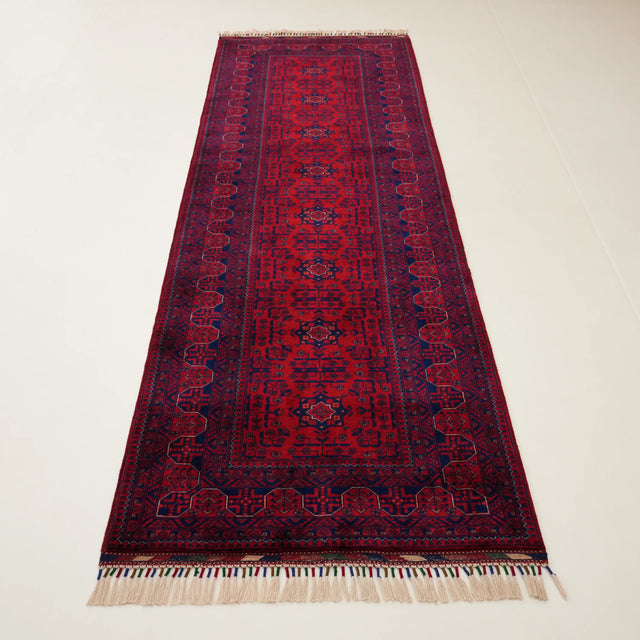
So the order of work reverses. With a loom-woven or machine-woven runner you choose a design and then a size; with a handwoven one you measure the corridor first, decide the width band you can live with, and then look at what exists. The Anadolu Şal runners in this collection are woven from Sivas and Zara shawl patterns, the Yağcıbedir pieces in indigo and madder from near Balıkesir, and the Afghan-pattern Bilicik runners in burgundy wool. See hand-knotted rugs for how those are built.
| Construction | Underfoot | Sizes available | Best for |
|---|---|---|---|
| Handwoven wool | Dense, springy, recovers from footfall | One-offs only, 60–110 cm wide | An entrance you want to look furnished, not fitted |
| Loom-woven wool or Tencel | Even, medium pile, flat-lying | Full 80 / 90 / 100 cm range, 150–500 cm long | Long corridors where a matched pair is needed |
| Flat-woven kilim | Thin, reversible, no pile to crush | Mostly 80–100 cm wide | Under a door that has little clearance |
| Machine-woven | Uniform, light, quick to lift and shake | Widest size grid, lowest price | Busy hallways, rented flats, kitchens |
Compare wool rugs and machine-woven rugs if the corridor also has to match a room next to it.
Measure the gap under the door before you buy, not after. A door leaf sweeps an arc across the floor, and the clearance under it is usually 8 to 15 mm — less than the pile height of many rugs. A runner thicker than that gap will lift as the door opens, drag, and eventually wear a curved scuff into the pile where the leaf crosses it.
Three ways out of it, in order of preference. Stop the runner short of the door's swing, so the arc lands on bare floor — this is usually possible in a corridor with doors along one side, and it is why the 30–40 cm end clearance exists. Choose a flat weave: a kilim or a thin machine-woven runner sits low enough to pass under most doors. Or, last, have the door trimmed, which is a joiner's job and permanent.
The same arithmetic applies to a door that opens onto an entrance hall from outside. There the runner should begin inside the arc, not under it, so that the door can be opened wide against a wall without the rug fighting it.
A runner sold by the length band is a floor runner, not a stair runner, and the two are not interchangeable. A stair installation is fitted work: the runner is cut to the flight, laid over each tread, pulled tight around the nosing — the rounded front lip of the tread that takes almost all the wear — and fixed at every riser with rods or staples so that it cannot creep. Nothing about that is achieved by laying a loose rug on a staircase.
A loose runner on stairs slides underfoot, and the nosing is exactly where it slides. If you want a runner on a flight, have it fitted by someone who does that work, and expect to replace it before the floor runners in the same house, because the nosings wear first and wear hardest. A stair landing is a different matter: that is a floor, and a short runner in the 140–200 cm band sits on it perfectly well.
Corridors are the one place a rug genuinely moves, because footfall lands on it from a consistent direction. A gripper underlay or a mesh pad under the runner solves it; anti-slip tape along the two long edges solves the specific problem of a runner that walks sideways on tile.
Beyond that, rotate the runner end for end twice a year. Traffic in a corridor is not evenly distributed — the meter nearest the front door takes several times the wear of the far end — and turning it is the cheapest thing you will ever do for a rug's life. Vacuum along the length rather than across it, and read our runner selection guide before committing to a long piece.
Leave 10 to 20 cm of bare floor on each side. A 100 cm corridor takes an 80 cm runner and a 120 cm corridor takes a 100 cm one. Measure at the narrowest point of the passage rather than the widest.
Standard widths are 80, 90 and 100 cm, with lengths from 140 cm to 500 cm. Handwoven runners are single pieces off one loom, so they fall outside that grid at sizes such as 76 × 310 or 84 × 302 cm.
Use two runners of the same design laid end to end with about 20 cm between them. The gap shows the floor, breaks the length into sections the eye can read, and avoids the sag a single overlong rug develops.
Measure the clearance under the leaf first, since it is usually 8 to 15 mm. Either stop the runner short of the door's swing, which is what the 30 to 40 cm end clearance is for, or choose a flat weave low enough to pass beneath it.
Not loose. A stair runner is fitted work, cut to the flight and fixed at every riser so it holds tight around each nosing, and a rug simply laid on treads will slide. A stair landing is a floor and takes an ordinary short runner.
Put a gripper underlay or mesh pad beneath it, and run anti-slip tape along the two long edges if the runner tends to walk sideways rather than lengthways.
Handwoven and loom-woven wool, because wool pile springs back after footfall instead of flattening permanently. A machine-woven runner costs far less and is easier to lift and shake, which suits a corridor that gets dirty rather than one that gets worn.
Related collections: entrance hall rugs · handwoven kilims · round rugs · wool rugs