
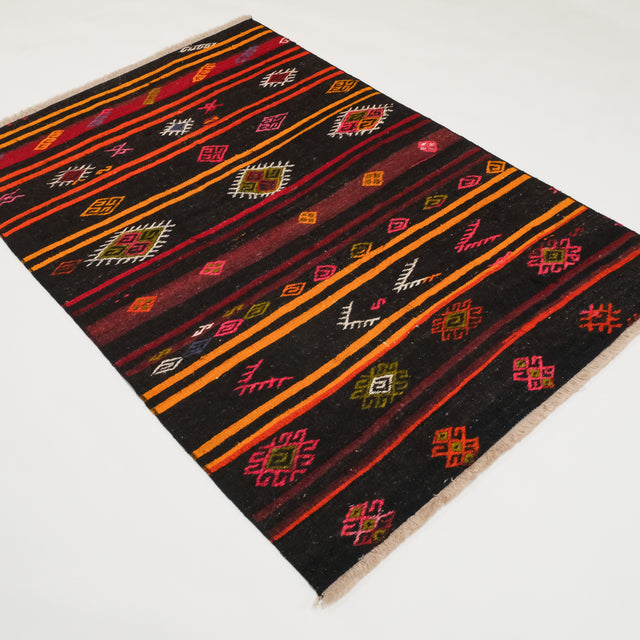
Four colors take turns up a black flatweave, all wool
 120×180 cm



Rugs & Kilims
Find Your Rug
For those who already know what they are looking for — Halıcızade's most visited collections.
Four colors take turns up a black flatweave, all wool
120×180 cm
Two meters across: black circle, silver frame, mostly viscose
 200×200 cm
Cream and red medallion on a black ground, silk in the pile
 167×241 cm
Corridor width in cicim: black ground, motifs in added yarn
 96×250 cm
Flowers built out of steps: a Karabagh kilim that traveled
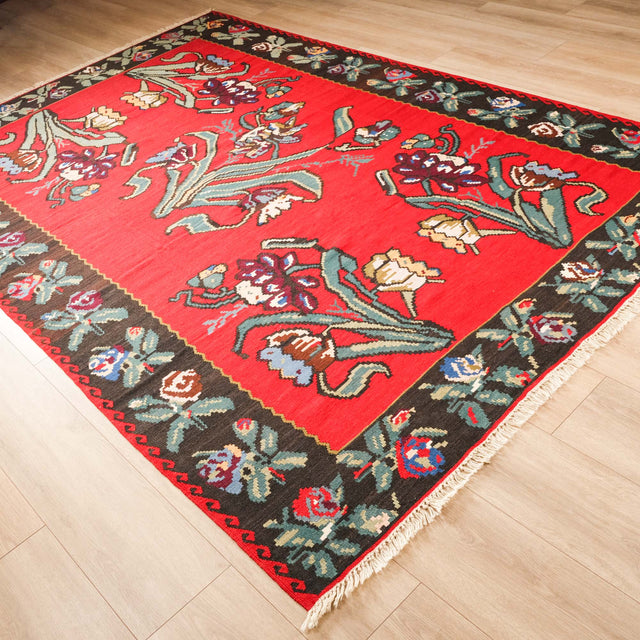 209×312 cm
Karabagh roses at full size, woven in Moldova
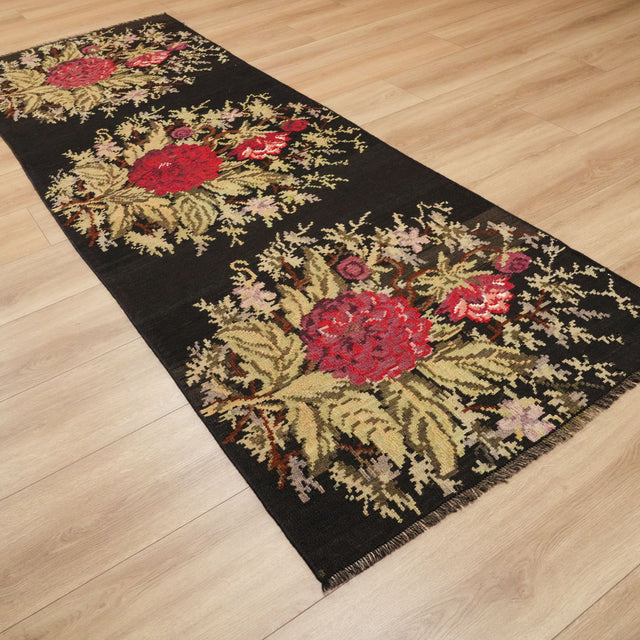 94×268 cm
Geometric motifs under black dye, 114 × 205 cm
 114×205 cm
An uneven black, 158 × 244 cm of sheared wool
 158×244 cm
Half the surface is border: black center, cream shawl figures
 200×300 cm
White lines on black, nothing else: wool on Aegean looms
 250×350 cm
Karabagh flowers on black, the tassels dyed to match them
 109×169 cm
Flower heads that shift row to row, black wool from Afghanistan
 173×240 cm
Karabagh roses on black, double-knotted in Afghanistan
 215×301 cm
Anthracite gray; the quarter that is not silk is Erzurum wool
 250×312 cm
One of a kind
from
470.000 TL
≈ 60.000 TL/m²
Silk lit against black wool, a drawn frame, 83 × 293 cm
 83×293 cm
One of a kind
from
36.500 TL
≈ 15.000 TL/m²
Unbroken black in Tencel®, a single mark for the forehead
 80×130 cm
One of a kind
from
14.000 TL
≈ 13.500 TL/m²
Caucasian Karabagh drawing over black, knotted in Afghanistan
 126×183 cm
Siirt mohair, black and patternless, with a nap left long
 133×185 cm
A village hand, not a court one: black ground, wool face throughout
 173×253 cm
One fine cream line around a black field, viscose on cotton
 300×400 cm
Vine work and medallions over red-brown, wool at a tight knot
 196×272 cm
Black over white, and the outline belongs to the animal
 170×188 cm
Leaf and flower edges broken down until they read as shadow
 120×180 cm
Black against silver: abstract drawing, two thirds of it viscose
 200×290 cm
A black rug is a floor covering woven or dyed predominantly in black tones, typically achieved through natural over-dyeing techniques or built through strong contrast against ivory or cream pattern elements in traditional Anatolian kilim weaving.
Black is one of the more decisive rug color choices, it rarely fades into the background of a room the way a neutral does, which means it rewards buyers who know what effect they want (grounding, dramatic, modern) but can overwhelm a room if chosen without a clear plan for the rest of the palette.
True solid black is comparatively rare in traditional natural-dye Turkish weaving, since achieving a deep, stable black from plant-based dyes historically required an intensive multi-step process. Much of what reads as 'black' in traditional pieces is actually a very deep brown or charcoal achieved through iron-based mordants, while true, deep black is more common in contemporary over-dyed and modern-loomed pieces, which is the primary source for our black collection today.
Our black collection includes two distinct approaches: solid or near-solid black grounds (a bold, modern, minimal statement) and traditional Anatolian kilim patterns built on strong black-and-ivory contrast, where black defines the pattern's structure rather than covering the full field. The two read very differently in a room, solid black as a modern anchor, contrast patterns as a more traditional, graphic statement.
We verify colorfastness carefully on solid black pieces specifically, since deep black dye run inconsistently is one of the more visible flaws a rug can show over time, any unevenness or fading toward brown or gray is far more noticeable in black than in most other colors.
Black works best when it's a deliberate anchor rather than an accidental default, pair it with enough light, either from the walls, furniture or natural light, that the room doesn't read as heavy.
| Solid / Near-Solid Black | Black-and-Ivory Contrast Pattern | |
|---|---|---|
| Visual effect | Modern, minimal, bold anchor | Traditional, graphic, high-contrast |
| Best rooms | Contemporary living rooms, entryways | Living rooms, hallways, eclectic interiors |
| Hides everyday wear | Very well | Very well, pattern also disguises soiling |
| Pairs well with | White, gray, brass, warm wood | Ivory, red, natural wood tones |
Black rugs are among the most forgiving colors for everyday soiling, but pet hair and light-colored debris (dust, lint) show more visibly on black than on mid-tone colors, so more frequent vacuuming keeps the color looking its best.
It can in a small or low-light room if used as a full room-size rug; in that case, using black as a runner or smaller accent, or ensuring the room has ample light, helps avoid this effect.
Deep, stable black is difficult to achieve consistently with traditional plant-based dyes; much of what reads as black in antique pieces is actually very deep brown or charcoal, while true black is more common in modern over-dyed and loomed pieces.
Yes, black is one of the most forgiving colors for everyday soiling, though light-colored debris like dust and pet hair can show more visibly than on mid-tone colors.
White, gray, brick red and warm wood tones all pair naturally with black; brass and warm lighting help prevent the combination from feeling too stark.
Yes, black-and-ivory kilims use black to define a traditional geometric pattern against a lighter ground, while solid black rugs are a modern, minimal, near-uniform black field.
Yes, black is a particularly practical entryway choice since it naturally disguises the everyday dirt and wear this high-traffic location receives.


