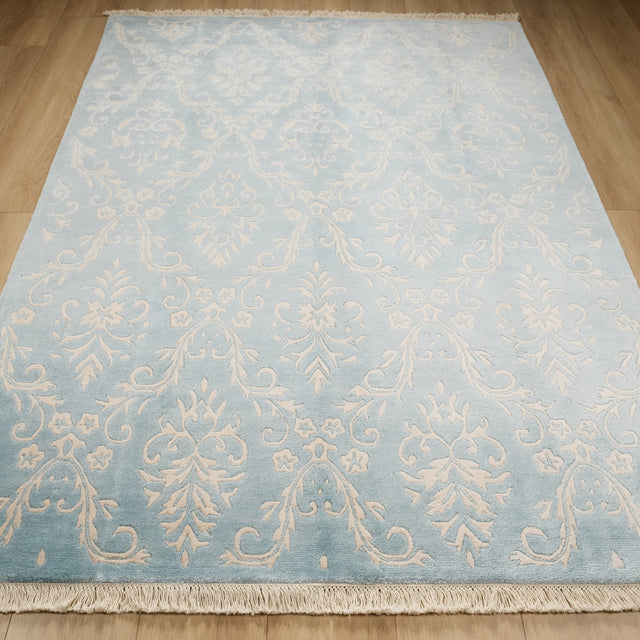
Damask in turquoise, tied row by row in India
 %60
270×375 cm
%60
270×375 cm

Turquoise Damask Hand-Knotted Bamboo Viscose Rug, Fiber Series
from
29.600 TLwas74.000 TL
%60 off≈ 4.900 TL/m²



Rugs & Kilims
Find Your Rug
For those who already know what they are looking for — Halıcızade's most visited collections.
Damask in turquoise, tied row by row in India
%60
270×375 cm
from
29.600 TLwas74.000 TL
%60 off≈ 4.900 TL/m²
Runner to salon, ten sizes: bamboo viscose damask on white
 %60
275×370 cm
%60
275×370 cm
from
10.400 TLwas26.000 TL
%60 off≈ 6.600 TL/m²
Cream only a shade above the anthracite, in three sizes
 %60
170×240 cm
%60
170×240 cm
Damask in white on white; only the light finds the figure
 %60
250×350 cm
%60
250×350 cm
Corridor lengths of cream, the damask scroll faded back
 %60
270×360 cm
%60
270×360 cm
from
15.200 TLwas38.000 TL
%60 off≈ 6.400 TL/m²
Matt brown ground, and the damask lit by bamboo viscose
 %60
170×240 cm
%60
170×240 cm
Silver-gray at 175 × 245 cm, the damask figures drawn open
 %60
175×245 cm
%60
175×245 cm
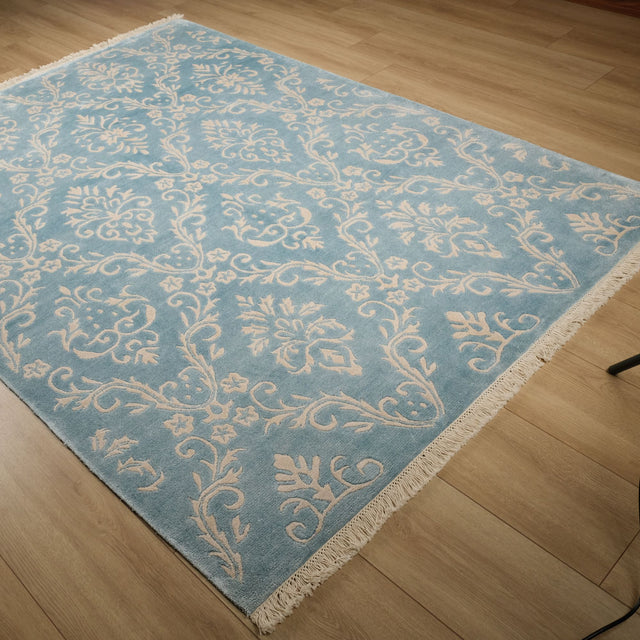
Bamboo viscose in turquoise: the shine is the yarn, not a finish
 %60
230×330 cm
%60
230×330 cm
from
31.200 TLwas78.000 TL
%60 off≈ 5.000 TL/m²
Cream under a brown damask repeat, hand-knotted in India
 %60
172×245 cm
%60
172×245 cm
Damask in purple over black, handwoven in India
 %60
250×300 cm
%60
250×300 cm
Brown that goes metallic under a window, cotton underneath
 %60
200×300 cm
%60
200×300 cm
White on white, 270 × 370 cm, the damask read by angle
 %60
270×370 cm
%60
270×370 cm
One of a kind
from
74.000 TLwas185.000 TL
%60 off≈ 7.400 TL/m²
The pattern kept to the border, and worked in bamboo viscose
 %60
200×300 cm
%60
200×300 cm
Silver shot with mink, the damask standing a millimeter proud
 227×323 cm
Knotted close enough to keep the damask curves, in powder pink
 %60
163×240 cm
%60
163×240 cm
Damask drawn in cream over a beige cowhide ground
 180×240 cm
Nothing woven in it: cut skins, blacks gathered to the middle
 119×182 cm
Damask cut in black and tan hide, 89 × 150 cm
 89×150 cm
Pale hide showing its whorls, the damask drawn in tone alone
 89×150 cm
Damask on black: shine from bamboo viscose, body from wool
 %60
170×242 cm
%60
170×242 cm
Ninety-two centimeters of cream, damask closed up tight
 %60
92×148 cm
%60
92×148 cm
Silver damask, eighty centimeters of a much longer scroll
 %60
80×150 cm
%60
80×150 cm
One of a kind
from
7.200 TLwas18.000 TL
%60 off≈ 6.000 TL/m²
Ironwork scrolls in pale purple, bamboo viscose on cream
 %60
200×300 cm
%60
200×300 cm
from
16.400 TLwas41.000 TL
%60 off≈ 6.600 TL/m²
Gray easing into pastel, wool and bamboo viscose over cotton
 %60
80×300 cm
%60
80×300 cm
One of a kind
from
15.600 TLwas39.000 TL
%60 off≈ 6.600 TL/m²
A damask rug carries the damask motif: a symmetrical repeating ornament built from a stylized flower or pomegranate inside a pointed oval frame, set in staggered rows across the field. The rugs here are handwoven in India and Türkiye in bamboo-viscose, wool and silk-blend yarn, in sizes from 90 × 150 cm (2'11" × 4'11") to 275 × 370 cm (9' × 12'2").
The pattern is older than the word we use for it in furnishing. It reached European weaving through Damascus, gave its name to the silk cloth, and was carried into wallpaper, upholstery and eventually rugs — which is why a damask rug tends to look right in a room where the curtains and the walls are doing something similar. What follows is what the motif actually is, what the rugs on this page are made of, and how a repeating ornament behaves on a floor.
A single ornament, mirrored down its own axis and repeated on a staggered grid. That is the whole definition, and everything else is a variation on it.
The core unit is usually a stylized flower, palmette or pomegranate held inside a pointed oval — the shape a textile historian would call an ogee. Each unit is symmetrical left to right but not top to bottom, and the rows are offset so that a unit in one row sits between two in the row above. The eye reads it as a continuous field rather than as a set of separate figures, which is why damask holds up on a floor where a single large medallion would be cut in half by a sofa.
On a rug, that has one practical consequence. There is no center. A damask field can be placed anywhere in a room, turned 90 degrees, or half covered by furniture, and it still reads as intact — unlike a medallion rug, which has to be centered on something.
Forty rugs, and almost all of them are handwoven.
Compare hand-knotted rugs for how a handwoven pile is built, and classic rugs for the older pattern families the damask sits beside.
The distinction decides how loud the rug is in a room, and it is the choice worth making first.
| Tone-on-tone | Two-color contrast | |
|---|---|---|
| How the pattern shows | Through sheen and pile direction — visible from one angle, nearly gone from another | Through color; visible from everywhere in the room |
| Typical colors here | Cream on cream, silver on gray, white on white | Black on cream, turquoise on cream, brown on beige |
| Suits | A room with patterned curtains, wallpaper or upholstery already | A plain room where the rug is the pattern |
| Fiber | Bamboo-viscose, silk blend | Wool, wool-and-bamboo |
A tone-on-tone damask is the more useful rug in practice, because damask is a furnishing pattern before it is a rug pattern. If the curtains, the wallpaper or the sofa already carry an ogee repeat, a rug in the same drawing but the same color as itself echoes them without competing.
The collection runs across the full range, and the repeat size changes with it. On a small rug the ogee units read individually; on a 270 × 375 cm piece they read as texture.
Rugs in this collection are tagged for professional washing, and the bamboo-viscose ones especially should never be soaked — viscose loses most of its strength while wet, and a rug washed at home in that fiber comes back stiff and dull.
Between washes the routine is short. Vacuum in the direction of the pile without the beater bar. Blot spills rather than rubbing them, because rubbing a lustrous fiber breaks the surface and leaves a matte patch that shows more than the stain did. Rotate the rug twice a year — a sheen-based pattern shows footpath wear as a change in reflection long before it shows as a change in color, and rotating spreads it. Keep it out of a strip of direct sun from a south window.
A symmetrical ornament — usually a stylized flower, palmette or pomegranate inside a pointed oval — repeated in staggered rows across a field. Each unit mirrors down its own axis, and the offset rows make the eye read the field as continuous rather than as separate figures.
Both, depending on how they are colored. The same drawing in cream on cream reads as a modern textured surface, while the same drawing in black on cream reads as a classical furnishing pattern.
Mostly bamboo-viscose yarn, handwoven in India, with a second group in wool and a small group of silk-blend pieces woven in Türkiye. The bamboo-viscose has the sheen that makes tone-on-tone patterning possible.
No. A damask field has no central medallion, so it can be placed off-center, turned or half covered by furniture and still read as complete. That is its main practical advantage over a medallion rug.
Yes, if the rug is tone-on-tone. Damask began as a furnishing pattern, so a rug carrying the same ogee repeat in a single color echoes patterned curtains or wallpaper instead of competing with them.
Professionally. The rugs in this collection are tagged for professional washing, and bamboo-viscose in particular should never be soaked, since the fiber loses most of its strength while wet and dries stiff.
170 × 240 or 200 × 300 cm for most rooms, where the front legs of the seating stand on the rug. For a large salon with the whole seating group on the rug, 230 × 330 to 275 × 370 cm.
Related collections: classic rugs · medallion rugs · bamboo rugs · floral rugs