
One red carried at several depths, 202 × 300 cm of wool
 202×300 cm



Rugs & Kilims
Find Your Rug
For those who already know what they are looking for — Halıcızade's most visited collections.
One red carried at several depths, 202 × 300 cm of wool
202×300 cm
Deep navy, no pattern at all, two loops to every warp pair
 200×300 cm
Döşemealtı red, uneven because the yarn came off a spindle
 130×216 cm
Chest-kept Herki runner, orange shifting batch by batch
 80×346 cm
Karabagh roses on black, double-knotted in Afghanistan
 215×301 cm
Pinhan means hidden, and the color runs mustard into gold
 204×297 cm
Mustard and gold on wool, tied with the double knot
 202×308 cm
Flower heads that shift row to row, black wool from Afghanistan
 173×240 cm
Baloch burgundy with aubergine and camel wool, tied in Afghanistan
 91×136 cm
Two rows of medallions on mustard, knotted thin and close
 80×111 cm
Ranks of Turkmen medallions, hand-knotted in Afghan wool
 85×140 cm
Seven decades in a dowry chest, madder red, all wool
 106×176 cm
Beige squares in a grid that drifts, wool knotted loop by loop
 170×240 cm
Navy dyed to several strengths in one wool field
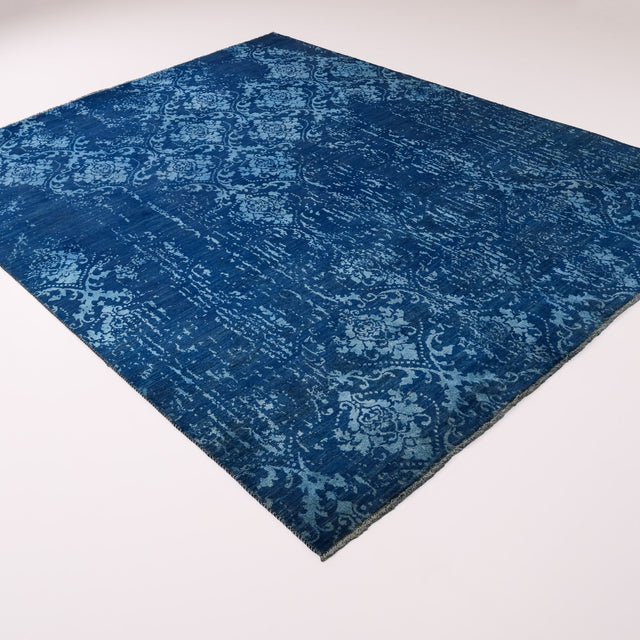 246×315 cm
Flowers in bamboo viscose, wool holding the yellow ground
 90×150 cm
Shawl motifs in rows, red leading blue and green
 155×204 cm
One of a kind
from
55.500 TL
≈ 17.500 TL/m²
Zara registers running across a yellow wool ground
 124×178 cm
Two thousand knots per ten square centimeters, and every color
 161×216 cm
One of a kind
from
80.000 TL
≈ 23.000 TL/m²
Turkmen looms, a mustard field, figures a few tones under
 176×246 cm
An empty cream center, mustard bands, wool over cotton
 125×179 cm
One of a kind
from
45.000 TL
≈ 20.000 TL/m²
Blue on blue, double-knotted, one piece in every size
 243×345 cm
Red quieted by a cream medallion, silk and viscose in the pile
 91×152 cm
Fuchsia against anthracite, panels out of Bünyan, Isparta, Ladik
 111×170 cm
Medallion at the center, burgundy at the edge, silk throughout
 60×93 cm
A hand-knotted rug is one in which every tuft of pile has been tied around the warp threads by hand, row by row, on a loom. Nothing about the pile is mechanical. In Anatolia the knot used is the symmetrical Gördes knot, the yarn is wool, cotton or silk, and a single room-sized rug takes a weaver months.
These are the slowest things in the catalog and the ones most often imitated. What follows is how the knot is formed, which Anatolian districts weave what, how to read the back of a rug in a shop, and how to wash and store one so that it lasts the decades it is capable of lasting.
A hand-knotted rug is built from the bottom up, one horizontal row at a time. The warp is strung the full length of the loom and held under tension. The weaver ties a short length of yarn around each pair of warps, cuts it, moves along the row, and when the row is finished passes one or two weft threads across to lock it. Then the whole row is beaten down with an iron comb.
The rug grows a few millimeters an hour. When it comes off the loom the pile is uneven, and it is sheared level by hand afterward; the fringe at each end is not attached but is the warp itself, tied off. That is the single structural fact that separates hand-knotted work from everything a machine produces, and it is the fact a buyer can check in ten seconds.
Two knots account for almost every hand-knotted rug in the world. The Gördes knot, also called the Turkish or symmetrical knot, wraps the yarn around two warp threads and brings both ends up between them. It is secure, it sits square, and it draws straight lines and angles well — which is why Anatolian design is geometric.
The Senneh knot, the Persian or asymmetrical knot, loops around one warp and passes behind the next. It packs more tightly and turns corners more smoothly, which is why Persian workshops could draw vines, faces and script. Neither knot is stronger than the other. They draw differently, and the design tradition of each region followed the knot it used. See Persian rugs for the second family.
Handweaving in Türkiye clusters in a handful of provinces: Milas, Afyon, Sivas, Kayseri, Isparta and Antalya, with Milas and Isparta the most widely known. Each district kept its own palette, format and drawing.
| District or type | What distinguishes it |
|---|---|
| Oushak (Uşak) | Open fields and wide medallions in apricot, madder and soft blue; one of the earliest Anatolian weaving centers and a marker of settled village life. See Oushak rugs. |
| Kayseri | Central Anatolian workshop weaving, classical drawing reworked in wool, mercerized cotton and silk. See Kayseri rugs. |
| Taşpınar | Predominantly geometric drawing, carrying an old Anatolian repertoire with very little floral work. See Taşpınar rugs. |
| Milas | Muğla province; small formats, strong yellows and browns, and a distinctive narrow-necked prayer niche. See Milas rugs. |
| Malatya | Woven entirely in wool and colored with natural dyes; geometric drawing that follows the region's own repertoire. |
| Bünyan | Kayseri district, unusual in this group for combining a wool pile with a cotton warp, which gives a flatter, more regular back. |
| Nevşehir | Cappadocian weaving with a long documented history, grouped with Oushak as one of the older settled traditions. |
| Sivas | Eastern Anatolian workshop rugs, finer than village weaving and usually in a restrained palette. See Sivas rugs. |
| Afghan and Shirvan | Non-Anatolian traditions carried in the same trade; Shirvan from the Caucasus, both with a long history and now scarce in good condition. See Afghan rugs. |
| Bukhara | Central Asian Turkmen drawing, repeating gül medallions on a red ground; genuine old examples are increasingly hard to find. |
| Patchwork | The recent one. Panels cut from separate old rugs and rejoined into a single piece. See patchwork rugs. |
Color follows the same map. Persian weaving leans on red and blue; Anatolian weaving is broader, and yellow, orange and madder red run through it. Fiber is the other variable: wool for almost everything, cotton for warps and for a crisper pile, and silk where the drawing is fine enough to need it. Smaller formats include the handwoven prayer rug, which works as a prayer rug and equally as a small floor rug.
Almost everything. Turn it over and the pattern should be legible from behind, in rows that are visibly not quite straight. Hand-tied knots do not fall into perfect bands; they wander by a fraction of a millimeter, and the rows drift. A machine-woven back is a flat, even mesh, the pattern is muffled, and there is usually a backing material and a fringe sewn or glued on afterward.
Knot density is counted here as well, in knots per square decimeter. It is worth understanding what density does and does not buy. A higher count allows finer drawing — curved stems, small script, a face. It does not make a rug last longer. A coarse village rug in good highland wool will outwear a fine one, and the two are priced for different reasons. Read how to identify a handwoven rug for the tests in order.
Time is the other thing the back records. A small prayer-rug format may take a few weeks. A room-sized rug at a moderate density takes a single weaver several months, and a fine silk rug can take more than a year. That labor is the whole of the gap between this collection and machine-woven rugs.
Compare against Turkish rugs as a whole before deciding, and if the rug is being sold as old, read antique against vintage first. The house convention, which is trade usage and not issued by any authority, runs: antique 100 years or more, semi-antique 50 to 100, vintage 20 to 80, and new below that.
A hand-knotted rug is washed less often than any other kind of rug in the house. Day to day, a vacuum on a low setting takes the dust out of the pile; a lightly damp cloth drawn in the direction of the pile does the rest. Neither needs doing aggressively.
When it does need washing, the safe answer is a professional who handles hand-knotted work, or a dry clean. If it is washed at home, use a mild soap with no bleach in it. Bleach and harsh detergents make natural dyes run, and a run in a madder red cannot be undone. Air the rug first, work gently with a soft cloth or brush, rinse the cleaner out completely, and get it dry immediately in a cool, ventilated place. A rug left damp will smell and eventually rot, and a rug dried in direct sun will fade. See how a rug is washed.
Vacuum and wipe the rug down before it goes away, and lift loose hair and lint off the surface with a soft brush. Roll it; never fold it. A fold sets a crease into the foundation that will still be there years later, and in an old rug the crease line is where the warp eventually breaks.
Store it at room temperature. Extreme heat and extreme cold both work on wool and on the foundation, and damp is worse than either. Wool is food for moths, so a stored rug needs a moth deterrent and needs unrolling and airing periodically rather than being left untouched for years.
The Gördes knot is symmetrical and wraps two warp threads, which suits geometric drawing and is standard in Anatolia. The Senneh knot is asymmetrical, loops one warp, packs tighter and allows the curved floral drawing associated with Persian workshops.
Turn it over. A hand-knotted back shows the pattern clearly in rows of knots that drift slightly out of line, and the fringe is the warp itself. A machine-made back is an even mesh with a backing and a fringe sewn or glued on.
There is no single figure. Density is counted in knots per square decimeter and decides how fine the drawing can be, not how long the rug lasts. Village rugs are coarse by design and can outlast much finer workshop pieces.
A small prayer-rug format takes a few weeks. A room-sized rug at moderate density takes one weaver several months, and a fine silk rug can take more than a year. The labor is what separates the price from a machine-woven rug.
The main provinces are Milas, Afyon, Sivas, Kayseri, Isparta and Antalya, with Milas and Isparta the most widely recognized. Taşpınar, Malatya, Bünyan and Nevşehir each keep their own palette, format and drawing.
Vacuum it, brush off loose lint, then roll it rather than folding it, because a fold sets a permanent crease into the foundation. Keep it at room temperature away from damp, use a moth deterrent, and unroll and air it periodically.
It can, with care, but professional washing or dry cleaning is safer. Use a mild soap with no bleach, since bleach and harsh detergents make natural dyes run, then rinse fully and dry the rug quickly in a cool, ventilated place.
Every hand-knotted rug above passes through Halıcızade Halı Kilim in Çayyolu, Ankara, where the back is read and the knot count recorded before the rug is listed.
Last updated: 10 September 2026
Related collections: wool rugs · silk rugs · Sivas rugs · Turkish rugs


