
Kula in Manisa: hooked figures over a cream ground
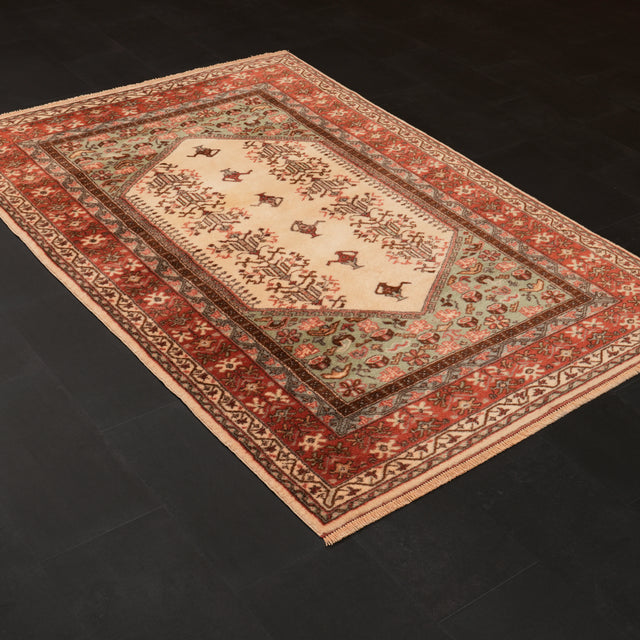 132×190 cm



Rugs & Kilims
Find Your Rug
For those who already know what they are looking for — Halıcızade's most visited collections.
Kula in Manisa: hooked figures over a cream ground
132×190 cm
Cream Yörük wool, hooked figures, and years already on it
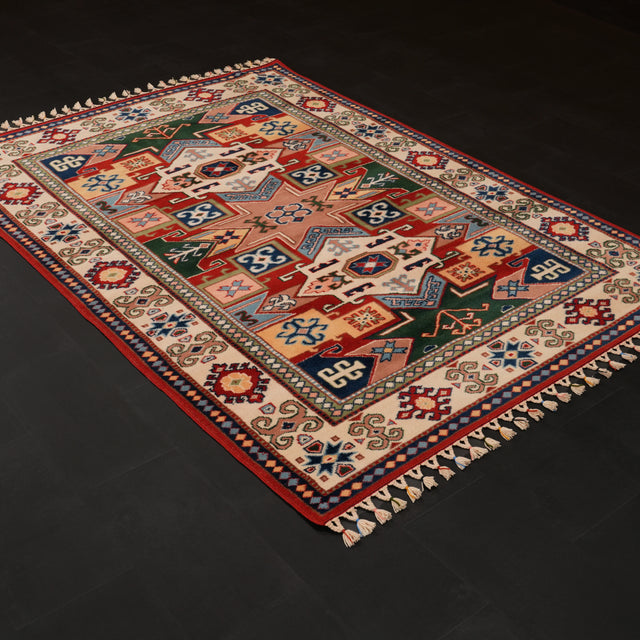 161×228 cm
Second-hand from Bünyan: cream ground, flowers in a frame
 197×288 cm
One of a kind
from
62.000 TL
≈ 11.000 TL/m²
Green where an Oushak is usually madder red
 149×203 cm
Seventy years out of a Kayseri village, wool throughout
 124×223 cm
Brown ground, ochre out of local plants: a Milas weave
 160×250 cm
Red kept in a chest, not on a floor: Bünyan knotting
 196×289 cm
A corridor of wool panels, each one a different figure
 80×290 cm
One of a kind
from
84.000 TL
≈ 36.000 TL/m²
Green where an Afghan loom usually gives red, all angles
 169×251 cm
Stepped diamonds and hooked medallions, multicolor wool
 178×239 cm
One of a kind
from
75.000 TL
≈ 17.500 TL/m²
Anatolian cicim, wool and cotton, the motifs raised off the weave
 186×277 cm
Panels drawn after Hereke, Kayseri and Oushak, woven in India
 200×300 cm
Wool wrapped, not knotted: a soumak past eighty years
 172×263 cm
Hand-spindle yarn, seventy years in a chest, Niğde wool
 162×279 cm
One of a kind
from
98.000 TL
≈ 22.000 TL/m²
Madder red folded away for seventy years, Antep wool
 116×235 cm
Green out of two dye baths, ninety years of Dazkırı wool
 98×115 cm
Turquoise and mustard, banded top and bottom over deep red
 203×303 cm
Reds at several depths, the drawing waiting at the frame
 165×235 cm
Wool patchwork, 123 × 209 cm, seams where a pattern would be
 123×209 cm
One of a kind
from
93.000 TL
≈ 36.000 TL/m²
Shawl bands in orange and plum, 124 × 182 cm of wool
 124×182 cm
One of a kind
from
82.000 TL
≈ 36.000 TL/m²
Pinhan means hidden: mustard ground, Anatolian bands at both ends
 244×344 cm
Nearly square at 250 × 270 cm, banded and bordered dark green
 250×270 cm
One of a kind
from
245.000 TL
≈ 36.000 TL/m²
Bijar in plum-navy, its motifs small enough to count one by one
 131×199 cm
A second-hand Yörük rug: wool on wool, colors already softened
 126×202 cm
An Anatolian rug is a rug woven in Anatolia, the Asian landmass of Türkiye, on a loom set up in a village house or a town workshop. The term is geographic rather than stylistic: it covers Oushak, Milas, Konya, Kayseri, Yağcıbedir and dozens of smaller traditions, each with its own palette and its own way of drawing a motif.
This collection runs from ninety-year-old village weavings that came out of a dowry chest to current loom-woven production. What follows is what the word covers on the map, how the main regional schools differ once a rug is on the floor, and how to tell a village piece from a workshop one with the thing in front of you.
It is the peninsula that forms the Asian part of Türkiye: the Black Sea to the north, the Aegean to the west, the Mediterranean to the south, and an eastern edge running through the highlands toward the Euphrates. Every rug woven inside that outline is, strictly speaking, Anatolian.
The word carries history as well as coordinates. Turkic peoples moved into the peninsula from Central Asia from the eleventh century onward and brought the knotted pile technique with them. The oldest surviving group of Anatolian rugs — large, coarse, boldly geometric — was found in the Alâeddin Mosque in Konya and dates to the Seljuk thirteenth century.
Sheep came with the migration. Anatolian rugs are wool because the economy that made them was pastoral: the fleece was on the hillside and the loom was in the house, and the two facts are the same fact.
There is no Anatolian style; there is an Anatolian map. Palette and drawing change every hundred kilometers or so, and they change because the dyestuff at hand, the wool at hand and the pattern the woman at the next loom was using all changed.
| Region | Where | Drawing | Palette |
|---|---|---|---|
| Oushak (Uşak) | Western Anatolia | Open fields, large soft-edged medallions, a coarse and lustrous knot | Madder red, apricot, soft blue |
| Kula | Western Anatolia, near Uşak | Small fields inside many narrow borders stacked one on another | Muted ochre, brown, indigo |
| Milas | Muğla, southwest | Narrow-waisted niches and long thin borders | Brick red and a strong yellow |
| Konya and Karapınar | Central plateau | Large-scale geometry, few motifs, a good deal of open ground | Madder red, ivory, restrained blue |
| Kayseri and Bünyan | Central Anatolia, town workshops | Classical medallion and floral drawing at a finer knot count | Broad — court palettes rewoven for a wider market |
| Yağcıbedir | Balıkesir, northwest | Small dark rugs, a lantern medallion, dense borders | Indigo and madder, and almost nothing else |
Village weaving from Kars, Sivas, Niğde, Afyon and Denizli also sits in this collection, along with pieces woven to Anatolian drawing outside Türkiye. Those are described as Anatolian-patterned rather than as rugs of a named Anatolian town, and the distinction is worth holding onto.
The sharpest division in Anatolian rugs is not regional. It is a question of who set the design.
In a village, the loom stood in the house and the weaver worked from memory and from the rug her mother had made. There was no cartoon to follow. Sizes were governed by the width of the loom and by the room the rug was meant for, which is why village pieces arrive in formats like 124 × 223 cm (4'1" × 7'4") or 132 × 190 cm (4'4" × 6'3") rather than in catalog sizes. Motifs shift a little each time they repeat; borders sometimes run out of room and are cut short at the corner; warp and weft are both wool.
In a town workshop — Kayseri, Bünyan, Hereke — a cartoon hung above the loom, squared off so that one square meant one knot, and several weavers worked a single rug to it. Knot counts are higher and curves become possible; the two halves of a medallion match; the warp is usually cotton, which holds its length better than wool and keeps the rug square. Pairs and repeat sizes exist because the design can be rewoven exactly.
A third category sits alongside both: loom-woven rugs, made with a controlled weave structure on a hand-operated loom rather than tied knot by knot, in Anatolian drawing and at a lower price than hand-knotted work.
Turn the rug over first; nearly everything is legible from the back.
Our guide to how to identify a handwoven rug goes further into the checks.
Anatolian motifs are a written language that stopped being written. The readings below are the ones recorded in Anatolian motif glossaries; a weaver in one valley did not always mean by a hook what her counterpart two valleys over meant.
Taken together they record status, migration, grief, disaster, belief, marriage, waiting and love. A rug was one of the few surfaces on which a woman who did not write could set any of that down. The same vocabulary runs through Anatolian flat weaving, where the absence of pile leaves the drawing even more exposed.
Anatolian fleece is long-stapled and slightly oily, which is why the pile springs back after pressure and why an old rug can still hold light. Warp and weft in village work are the same wool; workshop rugs use cotton for the warp.
Dye is where the collection divides in two. The older pieces are dyed with madder and indigo — reds that go orange toward the tips, blues that read almost black in a dark room — and they carry abrash. Current production largely uses chemical dyes, which is not a fault but a different thing: the color is even from tip to root and stays where it was put.
Age is described here in the trade's own term. A rug listed as sandık eskisi, "old out of the chest," was woven for a dowry, folded into a wooden chest and stored rather than laid down, and it comes out at seventy or ninety years old with most of its pile standing. It is the reason a genuinely old Anatolian rug can look far less used than its date suggests.
Rotate it. Village rugs are not always square, and turning the rug end for end twice a year keeps light and traffic from settling into one half of it. Keep it out of a full south window, which fades madder faster than feet wear it. Set felt pads under sharp furniture feet, which cut the foundation before they wear the pile.
Blot spills immediately with a clean dry cloth, working from the outside of the mark inward, and use plain water for light soiling rather than a solvent. Press the moisture out with a towel and dry the rug flat, away from direct sun and away from a radiator. Have a hand-knotted wool rug professionally washed every twelve to eighteen months if it is in daily use. If it goes into storage, roll it rather than folding it, and air it periodically — wool in a closed chest is what moths are looking for.
An Anatolian rug is one woven in Anatolia, the Asian part of Türkiye. The term is geographic rather than stylistic, covering the Oushak, Kula, Milas, Konya, Kayseri and Yağcıbedir traditions among dozens of others, each with a distinct palette and manner of drawing.
In practice, almost. Nearly every Turkish rug is Anatolian, since Anatolia is where Turkish weaving happens. The exceptions are pieces drawing on adjacent Caucasian, Persian or Central Asian traditions, and rugs woven to Anatolian patterns in Afghanistan or India.
Oushak and Kula in the west, Milas in the southwest, Bergama and Yağcıbedir in the northwest, Konya and Karapınar on the central plateau, Kayseri and Bünyan in central Anatolia, and village weaving across Sivas, Niğde, Afyon, Denizli and Kars.
Look at the back and at the border corners. A workshop rug follows a squared cartoon, so its medallion halves match and its corners resolve; a village rug is measured by eye, so its rows wander and its border is often improvised where it turns.
Sandık eskisi means "old out of the chest." It describes a rug woven for a dowry and then stored folded in a wooden chest rather than laid on a floor, which is why such a piece can be seventy or ninety years old and still have most of its pile.
The pile is nearly always wool, because the weaving grew out of a pastoral economy. Village rugs use wool for the warp and weft as well; town workshops generally use a cotton warp, which keeps the rug square, and silk appears at the finest workshop end.
The Anatolian rugs above are gathered by Halıcızade Halı Kilim in Çayyolu, Ankara, district by district rather than by the crate.
Last updated: 10 September 2026
Related collections: Anatolian kilims · Turkish rugs


